

Two friends graduate together. Same course, same starting pay, same CPF contributions. Ten years on, one earns $15,000 a month and rents a nice apartment in town. The other earns $9,000 and owns a flat that has quietly gained $300,000 in value while she slept.
Ask yourself honestly: who is wealthier?
The headlines say Singapore has never been richer. Total household net worth crossed roughly S$3.1 trillion in 2025 and kept climbing into 2026, per the Department of Statistics. But averages hide the split. The real divide in Singapore today is not age, not postcode, not even salary. It is holdings. Some households own things that appreciate. Many — including plenty of six-figure earners — own nothing that does.
What does "salary rich, asset poor" actually mean?
It means your income statement looks great and your balance sheet is empty.
Income is cashflow. It arrives on the 25th, and by the next 25th most of it has left — rent, car, restaurants, holidays, subscriptions. Assets are wealth. They sit on your balance sheet and compound whether or not you show up to work.
Here is the uncomfortable part of the national wealth story: of that S$3.1 trillion, around 59% of household assets are residential property. The households getting richer are, overwhelmingly, the households that own. Meanwhile, a growing group of high earners is moving the other way — more consumption debt, not less. Bigger car loans. Buy-now-pay-later balances. Credit card rollovers at 26% interest, financing lifestyles that depreciate the moment they are purchased.
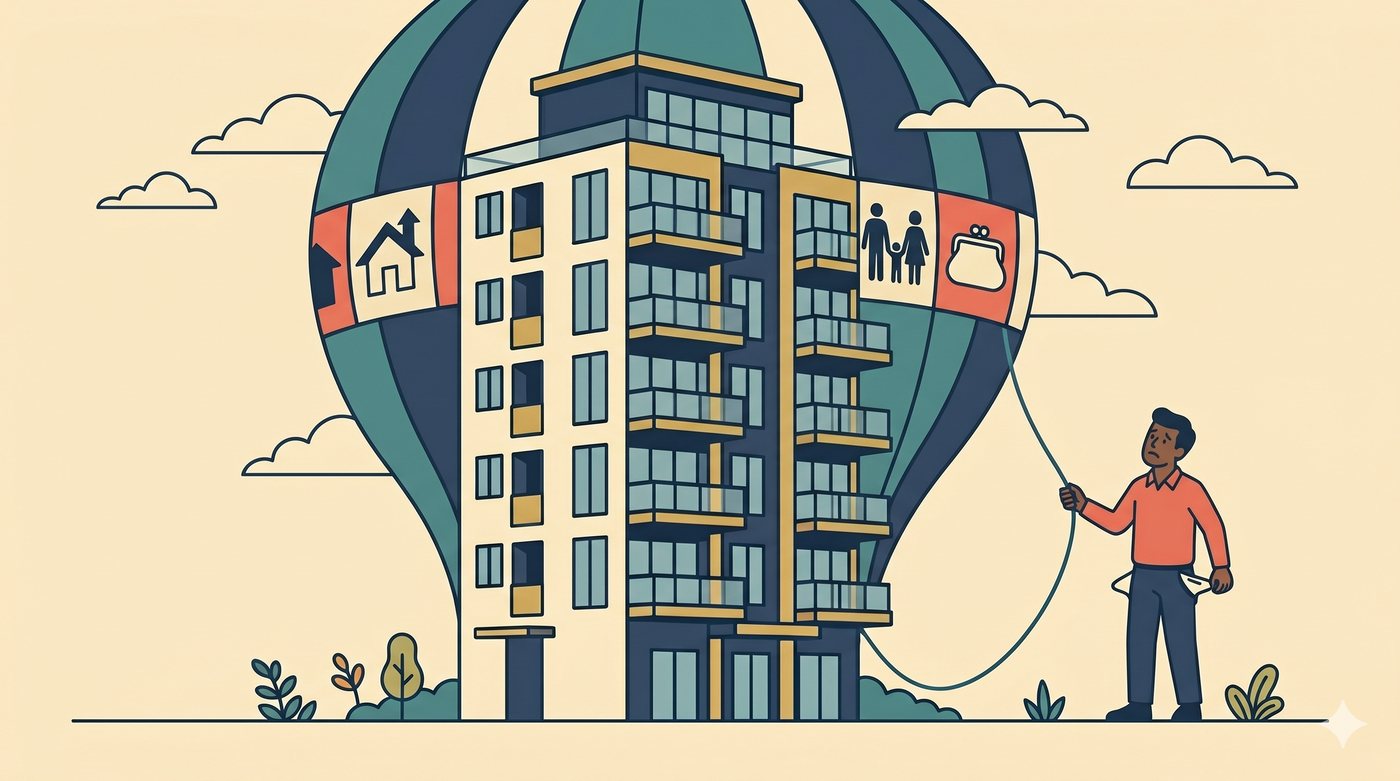
A $15,000 salary with no assets is not wealth. It is a larger pipe with nothing at the end of it.

Hey — quick hello, I’m Melvin
If we haven’t met: I’m Melvin Lau, a property strategist with PropNex (CEA R067207F). I don’t just open doors for viewings — I help homeowners sequence the big moves: when to sell, when to buy, how to upgrade or right-size without overpaying tax or getting financially stuck between two homes. Most of my work is exactly this kind of planning, done before anyone signs anything.
If any of this feels relevant to your own situation, just message me — no pitch, no obligation, happy to talk it through.
WhatsApp Melvin →Why isn't a high income making you wealthy?
Three quiet forces work against the salary-rich.
1. Lifestyle creep is automatic. Saving is not. Every increment gets absorbed — a nicer rental, a better car, one more holiday tier. Spending scales with income by default. Investing only scales with deliberate structure. Most people never build the structure.
2. Cash loses quietly. Money parked in a savings account earning 1–2% while core inflation runs above that is going backwards in real terms. It doesn't feel like a loss because the number on the screen never shrinks. But purchasing power does — every single year.
3. Income stops when you stop. A salary is rented, not owned. Retrenchment, illness, an industry downturn, or simply turning 60 — the pipe can close. Assets keep working. This is the difference between being paid and being wealthy, and it only becomes obvious at the worst possible time.
Why is property the asset progression vehicle Singaporeans actually execute on?
In theory, you could build the same wealth through equities, index funds, or a business. Some do. But look at what actually happens across the population, and property wins for three structural reasons.
Forced savings. Nobody skips their mortgage the way they skip their investment plan. Every monthly instalment quietly converts income into equity. It is the only savings plan with a 25-year track record of Singaporeans actually sticking to it — because the alternative is losing the roof.
Leverage. Under current rules, a first housing loan can finance up to 75% of the purchase price. That means $500,000 of capital controls a $2,000,000 asset. If that asset appreciates 20% over a holding period, the gain is $400,000 — an 80% return on your capital, before costs. No bank will lend you four times your money to buy index funds. They will for a home. That asymmetry is the entire game.
CPF deployment. Your Ordinary Account earns a steady 2.5%. Useful, safe — and for many people, hundreds of thousands of dollars sitting there doing exactly that for decades. Property is the one asset class CPF was designed to fund. Used well, it puts otherwise-locked money to work.
None of this means any property builds wealth. Singapore's market punishes lazy choices — the wrong lease profile, the wrong restrictions, the wrong entry price. I wrote about this in the BTO queue paradox, where a $455K flat drew no queue and a $1.59M EC sold out in a weekend. Buyers were not choosing by price. They were choosing by asset behaviour — and the data on why ECs remain one of the safest entry points per square foot tells the same story from another angle.
How do you start asset progression in Singapore?
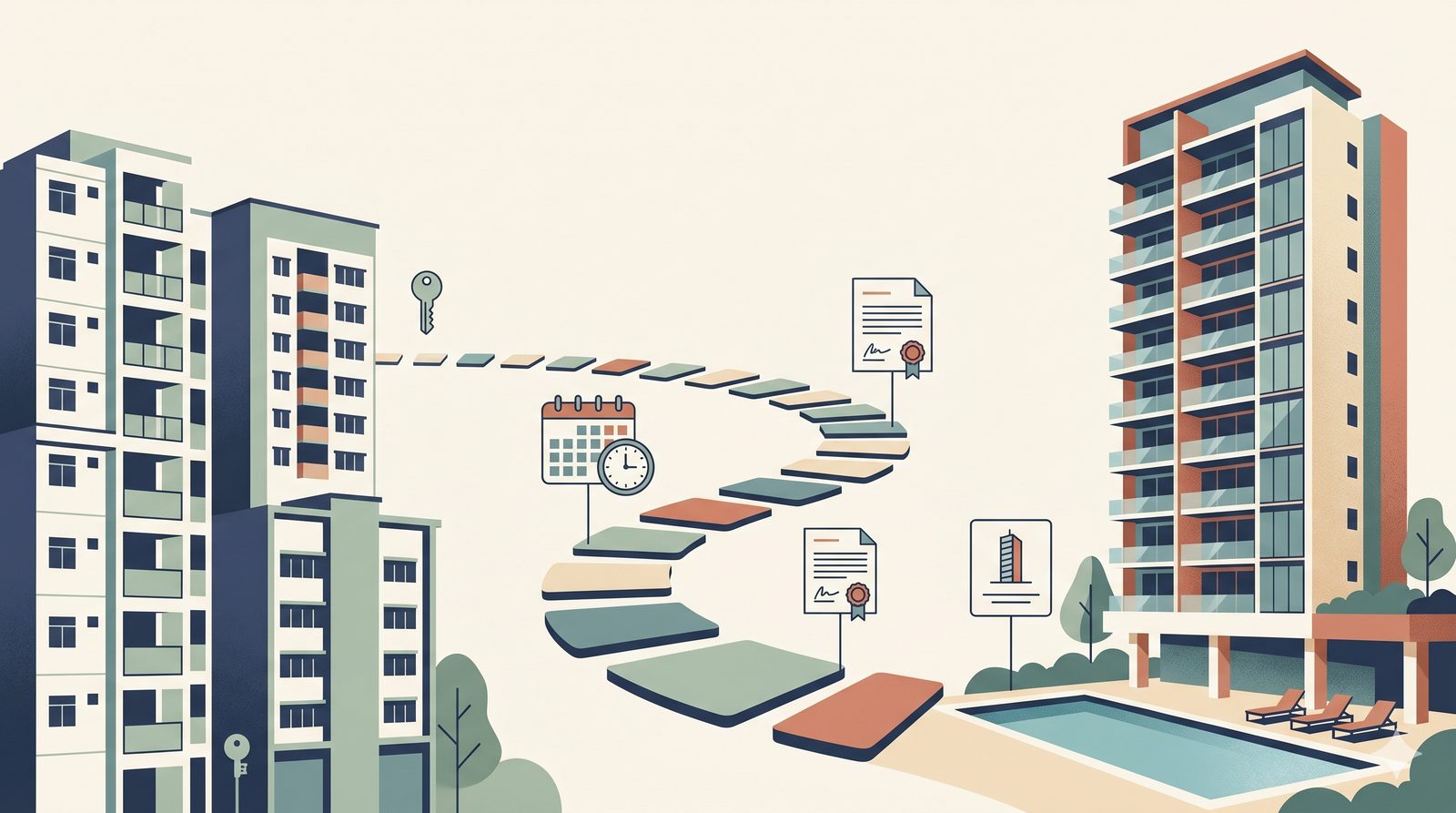
Not by rushing to a showflat. Start with arithmetic.
Step one: audit your balance sheet, not your payslip. List everything you own that appreciates — property, equities, CPF — and everything you owe. Most salary-rich households have never done this. The result is often sobering: a $180K annual income and a five-figure net worth.
Step two: map your firepower. CPF OA balance, cash savings, and your borrowing capacity under the 55% Total Debt Servicing Ratio. These three numbers define what is actually available to you — not what Instagram says your peers are buying.
Step three: match the asset to the timeline. A 28-year-old single, a 35-year-old upgrader and a 50-year-old rightsizer should not buy the same thing. Entry price, lease profile, exit restrictions and holding horizon all matter more than the marble in the lobby.
Step four: act within your window. Waiting has a price. It compounds quietly, the same way assets do — just against you. If you own a property today, knowing its current value is the obvious starting point; you can request a free valuation report here and anchor the conversation in real numbers.
The divide between salary-rich and asset-rich is not talent, luck, or even income. It is sequencing. The asset-rich started earlier, structured deliberately, and let leverage and time do the heavy lifting. The salary-rich are still waiting for the "right time" — while paying someone else's mortgage or financing a depreciating lifestyle.
Income pays for today. Assets pay for the rest of your life. The earlier you make that switch, the less heroic the math needs to be.
Figures referenced: Singapore Department of Statistics household sector balance sheet; MAS loan-to-value and TDSR rules. As at June 2026.
Frequently asked questions
What is asset progression in Singapore?
It is the deliberate process of moving from no appreciating assets, to a first property, to progressively better-performing ones — using savings, CPF and sale proceeds at each step. The goal: convert monthly income into net worth, not just expenses.
Is a high salary enough to build wealth?
No. Salary is cashflow; wealth is what remains and compounds. Without appreciating assets, a high income simply funds a more expensive month. The national data is blunt: most household wealth in Singapore sits in property, not payslips.
Why property instead of stocks?
Not instead — alongside. But property offers three things equities rarely match for ordinary households: forced savings via the mortgage, 75% bank leverage on a first loan, and the ability to deploy CPF OA funds. It is the wealth plan Singaporeans demonstrably follow through on.
I have no property yet. Where do I start?
With a net worth audit and three numbers: CPF OA balance, cash, and TDSR-based borrowing capacity. From there, work backwards to the right entry — BTO, resale, EC or private — based on your timeline, not your peers'.
Hi, I'm Melvin
Property strategist with PropNex (CEA R067207F). I help Singapore families work out when to sell, when to buy and how to sequence the big moves, with clear numbers and no pressure. The first conversation is free.
WhatsApp MelvinRelated reads

Planning your next property move?
The first conversation is complimentary — clear numbers, no hard selling.
WhatsApp Melvin →