INSIGHTS · Jun 10, 2026 · 7 min read
How Much Do You Need to Retire in Singapore? The $1.6 Million Wake-Up Call
Last month, a 28-year-old client asked me a simple question: "How much do I actually need to retire?"
Not retire rich. Not retire early. Just retire — fully paid flat, zero debt, and a modest $2,000 a month on top of CPF LIFE for daily life. Kopi, groceries, the occasional JB trip. A basic Singaporean retirement.
We ran the numbers together. The answer was more than $1.6 million in cash. He went quiet for a long time. Most people do.
How much does a "basic" retirement in Singapore actually cost?
Here is the setup. He retires at 65, in the year 2063. His flat is fully paid. He has no loans. He wants $2,000 a month in today's purchasing power from 65 to 86 — roughly Singapore's average life expectancy — on top of whatever CPF LIFE pays.
The problem is the 37 years between now and then. At a long-run inflation rate of 2.5% — Singapore's typical planning assumption — prices roughly double every 28 years. By the time he hits 65:
Item | Today (age 28) | At 65 (2063, 2.5% p.a. inflation) |
Target monthly lifestyle (on top of CPF LIFE) | $2,000 | ~$5,000 |
Annual cost | $24,000 | ~$60,000 |
Total from 65 to 86 (21 years, inflation continuing) | — | ~$1.63 million |
Read that middle row again. The $2,000 lifestyle does not stay $2,000. By 65 it costs about $5,000 a month — and inflation does not retire when you do. Across 21 years of retirement, the bill keeps climbing past $60,000 a year. Stack it all up and the total crosses $1.6 million. For a basic lifestyle. Before any medical shocks, before helping the kids, before a single holiday further than Bangkok.

Hey — quick hello, I’m Melvin
If we haven’t met: I’m Melvin Lau, a property strategist with PropNex (CEA R067207F). I don’t just open doors for viewings — I help homeowners sequence the big moves: when to sell, when to buy, how to upgrade or right-size without overpaying tax or getting financially stuck between two homes. Most of my work is exactly this kind of planning, done before anyone signs anything.
If any of this feels relevant to your own situation, just message me — no pitch, no obligation, happy to talk it through.
WhatsApp Melvin →Isn't CPF LIFE enough to cover retirement?
CPF LIFE is a floor, not a plan. A member who sets aside the 2026 Full Retirement Sum of $220,400 at age 55 is currently estimated to receive around $1,780 a month from 65 on the Standard Plan. That is genuinely valuable — it is lifelong, government-backed income. But it is calibrated to cover basic needs, in a future where "basic" costs $5,000 a month.
That is precisely why the client's target was $2,000 a month on top of CPF LIFE. The national annuity holds up the floor. Everything above the floor — your floor — is your problem to fund. I covered a related version of this gap in why $600K may not be enough for retirement; the arithmetic has not gotten kinder since.
"But my flat will be worth a million by then"
This is where most retirement conversations go next, and it deserves honest treatment.
Say his 4-room flat is notionally worth around $1 million by 2063. Sounds like the problem is solved — until you remember what that flat is by then: a 99-year leasehold with perhaps 50-odd years left and the meter running. A flat with a decaying lease is a melting ice cube. You can live in it. But every year, the thing you would exchange it for shrinks. Banks lend less against it. Buyers' CPF usage tightens. The pool of people who want it gets older and smaller. I have written before about how today's buyers already price restrictions and exit profiles into what they queue for — the market in 2063 will be even less sentimental.
Now run the standard rightsizing play:
- Sell the ageing 4-room at ~$1,000,000.
- Buy a 2-room Flexi at ~$500,000.
- Park the ~$600,000 net proceeds (including savings) at 3% and draw down $5,000 a month, rising with inflation.
The pool runs dry around age 76. Ten years before his planning horizon. The melting ice cube bought him a decade — not a retirement.
A fully paid flat is shelter. It is not income. Confusing the two is the most expensive mistake in Singaporean retirement planning.
So what actually closes a $1.6 million gap?
Time, leverage, and an asset that holds value — in that order.
At 28, time is the superpower. A 37-year runway means even moderate, consistent compounding gets you there. The same gap at 50 requires heroics. Every year of delay quietly raises the required monthly savings rate.
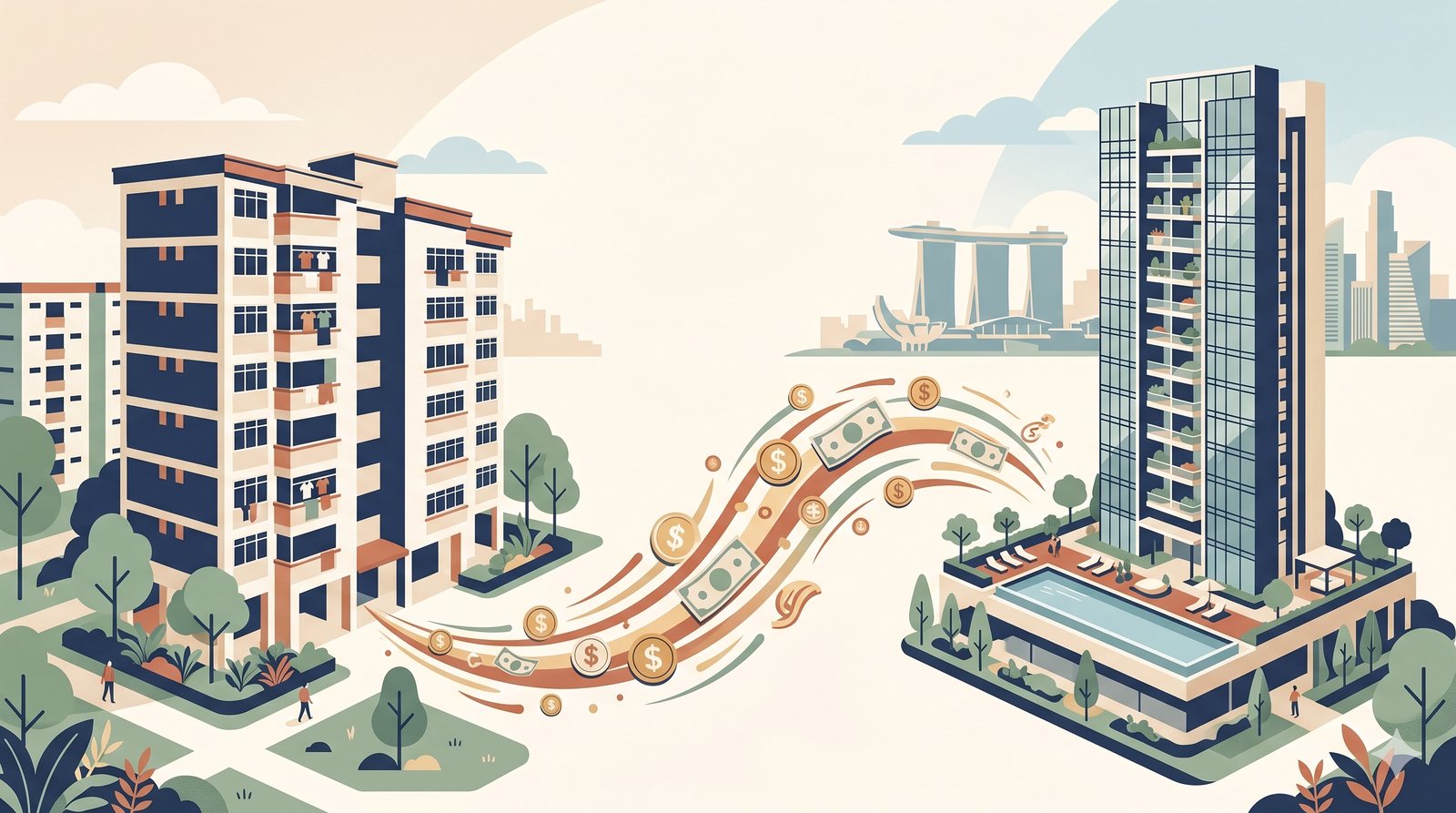
The flat you hold matters as much as the cash you save. Two households can pay identical mortgages for 30 years and retire with wildly different balance sheets — one holding an asset the open market still wants, the other holding a lease the market is discounting. Repositioning from a decaying asset into one that holds or grows value — while you still have income, loan eligibility and runway — is often worth more than a decade of disciplined saving.
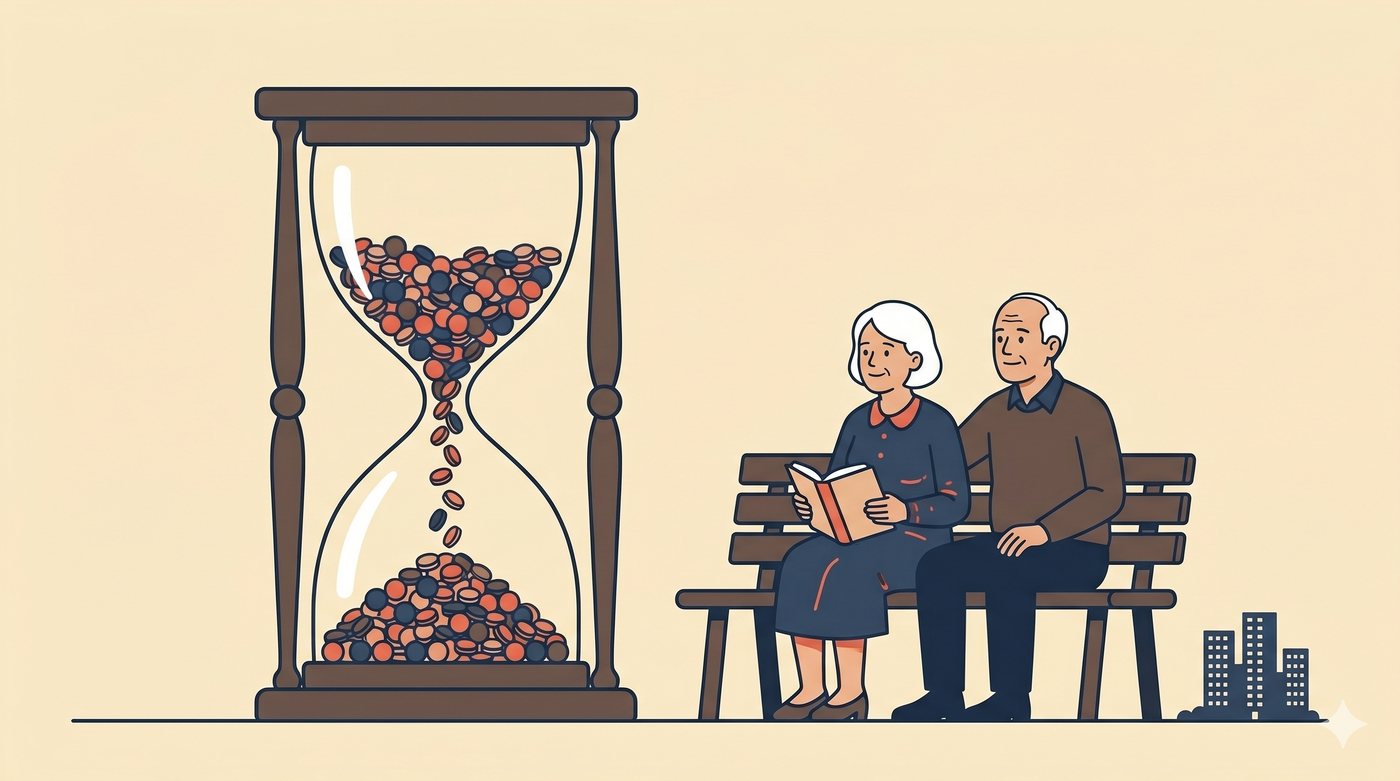
Property income changes the equation entirely. A retirement funded by drawdown is a countdown clock. A retirement part-funded by rental income or by rightsizing out of an appreciating asset is a renewable resource. The difference at 76 is everything.
Notice what is not on that list: picking winning stocks, timing the market, or earning a banker's salary. The households that retire comfortably in Singapore are rarely the ones that gambled well. They are the ones that bought a sound asset early, serviced it with discipline, and made one or two deliberate repositioning moves in their 40s and 50s while the options were still open. Boring, sequenced, repeatable.
None of this requires speculation or luck. It requires knowing three numbers: what your current home is realistically worth (you can get a free valuation report here), what it is likely to be worth at your retirement date given its lease profile, and what the gap is. Then you plan with decades of runway instead of discovering the shortfall at 64.
My client is 28. He has time to make this boring and achievable. The question is whether you do — and the only way to find out is to run your own numbers, honestly, today.
Assumptions: 2.5% long-run inflation; CPF LIFE estimates per CPF Board for the 2026 Full Retirement Sum, Standard Plan; illustrative flat values for 2063. As at June 2026.
Frequently asked questions
How much do I need to retire at 65 in Singapore?
For a 28-year-old targeting a basic lifestyle — paid-up home, no debt, $2,000 a month in today's dollars on top of CPF LIFE — roughly $1.6 million in cash across a 21-year retirement, once 2.5% inflation is applied over 37 years. Older readers need less inflation adjustment but have less time to accumulate.
Is CPF LIFE enough to live on?
It is a lifelong floor, not a full plan. Setting aside the 2026 Full Retirement Sum of $220,400 at 55 yields an estimated ~$1,780 a month from 65 on the Standard Plan. Most retirees need a meaningful top-up above that.
Can I just sell my flat to fund retirement?
Partially. Rightsizing an ageing 4-room (~$1M) into a 2-room Flexi (~$500K) and investing ~$600K at 3% supports an inflation-adjusted $5,000 a month only until your mid-70s. A decaying-lease flat funds a decade, not a retirement.
When should I start retirement planning with property?
While you still have three things: income, loan eligibility, and runway. Repositioning from a depreciating lease into an asset that holds value is far easier at 35 than at 55 — and nearly impossible at 65.