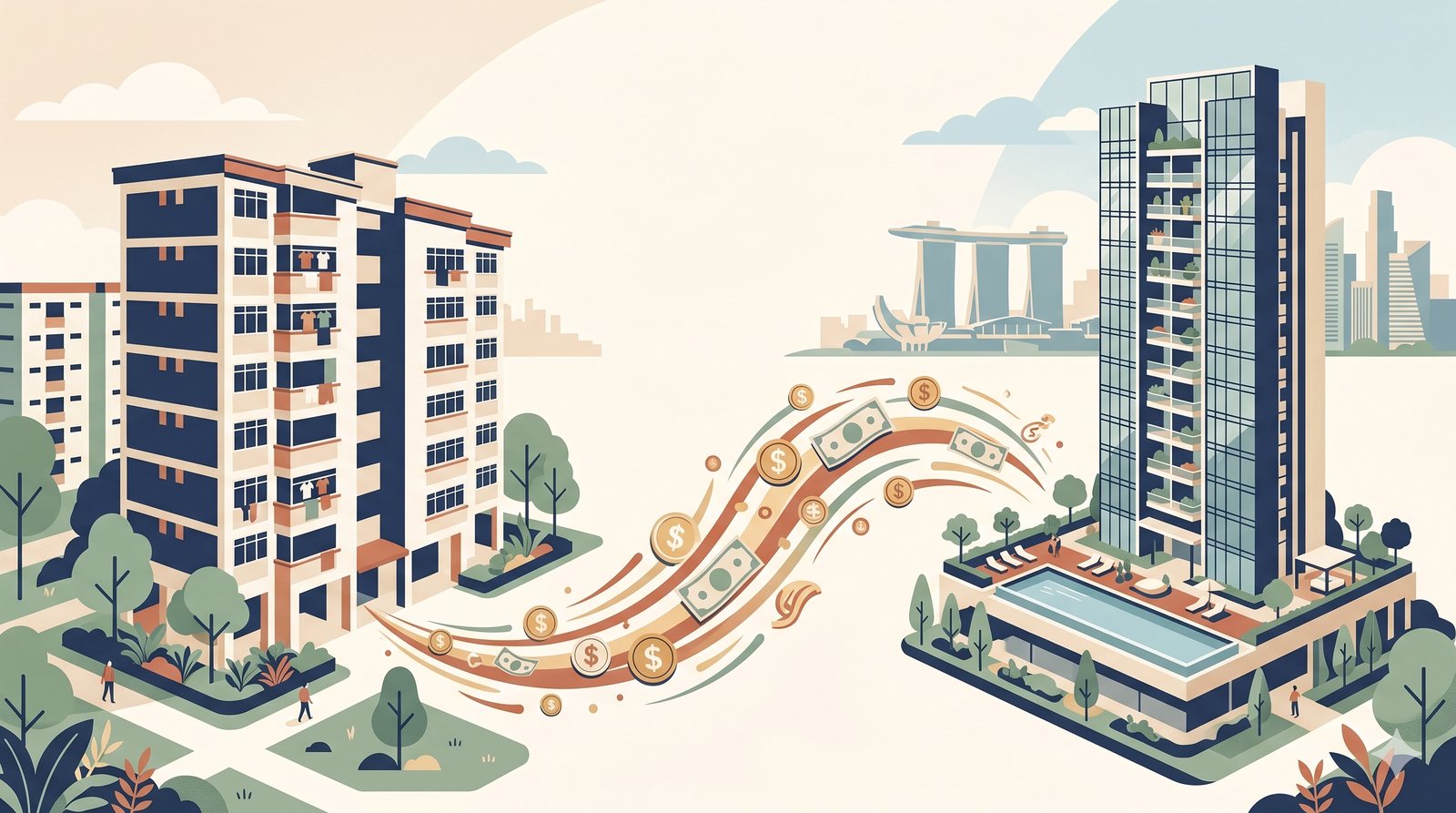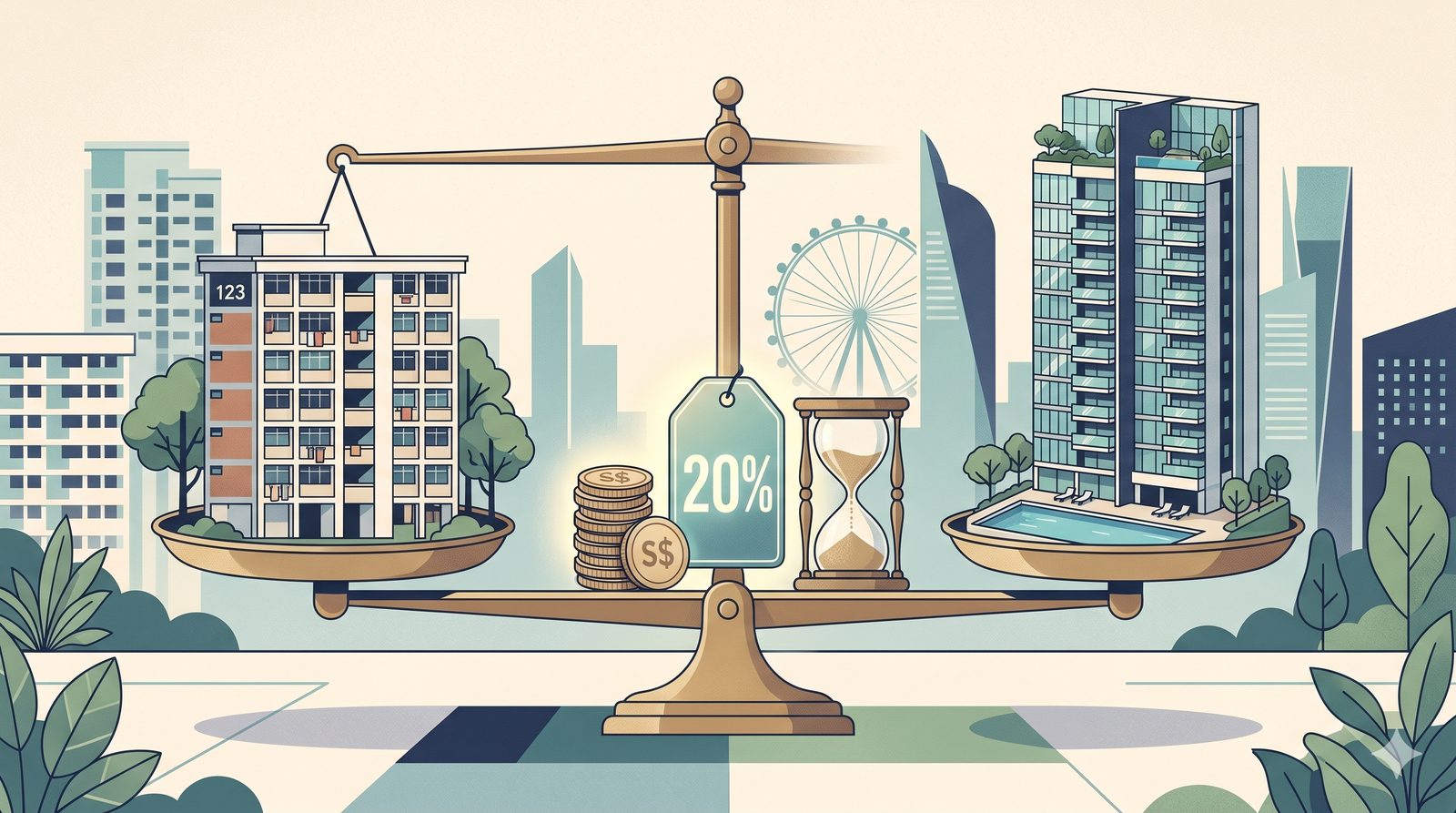
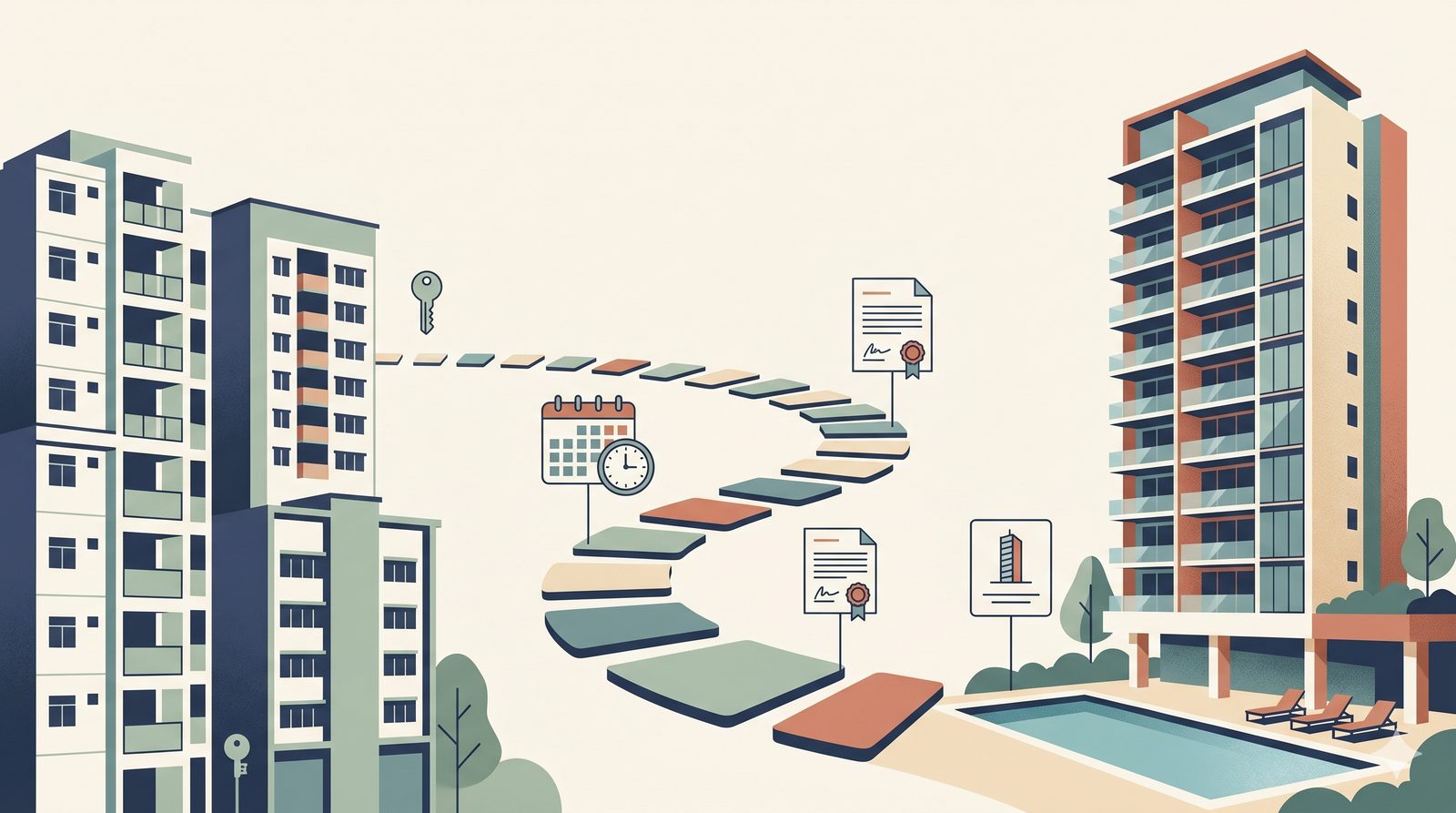
Most couples who come to me about upgrading have already decided what they want — a condo, a bit more space, a pool the kids will use twice a year. What almost none of them have figured out is the part that actually decides whether the upgrade works: the order, and the timing, of selling and buying.
Get the sequence right and you move once, sleep in your own bed the whole way through, and don’t pay a dollar of ABSD you can’t get back. Get it wrong and you’re either paying $300,000 in stamp duty you’ll fight to recover, or you’ve sold your flat and have nowhere to live. Same couple, same budget — wildly different outcomes, decided entirely by a calendar.
Here’s how the timeline actually works.
First: can you even buy a condo yet?
Before anything else, one hard gate. If your flat is still within its Minimum Occupation Period (MOP) — 5 years for the vast majority of flats — you cannot buy any private property at all. Not a condo, not a landed home, not an overseas one.
And here’s the part people miss: this restriction doesn’t only apply to the owners named on the lease. It also covers every essential occupier — so if your spouse, parent or child was listed as an essential occupier to form the family nucleus when you bought the flat, they’re barred from buying private property during MOP too. You can’t simply put the condo in your spouse’s name to get around it.
So step zero is simply: has your flat passed MOP? If not, the upgrade conversation is a planning conversation, not an action one — and that’s fine, because the planning is where the money is made anyway.
The two ways to sequence it
Assuming you’ve cleared MOP, every upgrade is really a choice between two sequences. I covered the tax mechanics in detail in how to avoid ABSD when upgrading — here we’re focused on the timeline.
Sequence A — Sell first, then buy (the zero-ABSD path)
You sell the flat, then buy the condo as a first-time owner. No ABSD, no refund to chase. The timeline:
| Stage | Rough duration |
|---|---|
| Get your flat valued, list, find a buyer | 2–8 weeks (market dependent) |
| Buyer exercises OTP → HDB resale completion | ~8–12 weeks |
| Temporary extension of stay (if you need it) | up to 3 months after completion |
| Buy condo as first property | concurrent / after |
The lever most people miss is the temporary extension of stay: with your buyer’s agreement (and it must be declared at the resale application), you can stay in your sold flat for up to 3 months after legal completion. That bridge is often exactly enough time to buy and renovate the condo — so you sell, stay put, then move once.
One thing to get right, because it trips people up: once legal completion happens, the flat legally belongs to the buyer. From that date, the buyer is the one liable for the mortgage, the S&CC (with no rebates), and property tax — at the higher non-owner-occupier rate, since they’re not living there. As the seller staying on, you don’t automatically “owe” those — but in practice you negotiate a private arrangement to compensate the buyer for that cost. Build that compensation into your sale terms upfront so it’s not a fight later.
Sequence B — Buy first, then sell (move-once, but you front the ABSD)
You buy the condo while still owning the flat, then sell the flat within the ABSD remission window. Because you own two properties at purchase, you pay 20% ABSD upfront — then claim it all back if you sell the flat in time.
The clock that matters: a married couple (at least one Singapore Citizen, condo in both names, no other property) must sell the flat within 6 months of the date they exercise the OTP on a completed condo. Sell in time, get the full refund. Miss it, and the $300,000 is gone.
Two things people underestimate here. First, that 20% ABSD is payable in cash within 14 days of exercising the OTP — you can’t pay it with CPF — so Sequence B only works if you genuinely have that liquidity sitting ready. Second, if you buy a new launch (uncompleted) condo instead of a resale one, the 6-month clock doesn’t start at purchase — it starts at the project’s TOP/CSC, often years later. That gives off-plan upgraders a long runway to keep living in the flat before they must sell. For the right buyer, that’s a genuinely powerful timing advantage.
The whole upgrade lives or dies on one date. In Sequence A it’s the extension-of-stay deadline; in Sequence B it’s the 6-month ABSD remission window. Pick your sequence, then build the entire move backwards from that one date.

Hey — quick hello, I’m Melvin
If we haven’t met: I’m Melvin Lau, a property strategist with PropNex (CEA R067207F). I don’t just open doors for viewings — I help homeowners sequence the big moves: when to sell, when to buy, how to upgrade or right-size without overpaying tax or getting financially stuck between two homes. Most of my work is exactly this kind of timeline-and-cash-flow planning, done before anyone signs anything.
If any of this is starting to feel relevant to your own situation, just message me — no pitch, no obligation, happy to talk it through.
WhatsApp Melvin →The piece that breaks most timelines: financing
The sequence question isn’t really about logistics — it’s about money on hand, and this is where DIY upgraders come unstuck.
You’ll need a valid HFE letter (HDB Flat Eligibility) before you can get an OTP or submit a resale application, and it’s valid for 9 months — HDB won’t extend it, so don’t pull it too early. More importantly, you need to know three numbers cold:
- Your cash and CPF on hand — enough to cover the condo downpayment, and in Sequence B, the 20% ABSD you’ll front before the refund lands.
- Your flat’s realistic sale price and speed — not the hopeful number, the market one. This sets how fast your bridge closes.
- Your loan eligibility on the condo — assessed while you may still be servicing the flat’s mortgage. TDSR doesn’t care about your feelings; it cares about your commitments.
Get those three right and the sequence picks itself. If you’ve got the cash to front ABSD comfortably, Sequence B lets you move once. If you don’t, Sequence A with an extension of stay is cleaner and cheaper. Get them wrong and you either overpay tax or end up owning two homes you can’t comfortably service.
So which sequence is right for you?
There’s no universal answer — that’s the honest truth, and anyone who gives you a one-size rule is selling something. It comes down to your cash position, how quickly your flat will sell, and how much disruption your family can absorb.
What I’d never do is start with the condo. I start with your numbers and your calendar, decide the sequence, then go shopping — because by then you know exactly what you can afford and exactly which deadline you’re working toward. The condo is the easy part. The timeline is the whole game.
You can get a free valuation of your flat here to anchor the most important number with something real — and from there the rest of the plan falls into place.
Figures and rules as at June 2026, per HDB, IRAS and CPF. MOP, HFE validity, ABSD remission windows and extension-of-stay rules are set by the authorities and can change — confirm current rules before acting.
Frequently asked questions
How long does it take to upgrade from HDB to a condo?
Plan for roughly 3 to 6 months end to end. An HDB resale sale takes about 8–12 weeks after the OTP is exercised, and you can arrange a temporary extension of stay of up to 3 months after completion to bridge the move. Buying and renovating the condo runs partly in parallel.
Should I sell my HDB first or buy the condo first?
If you have the cash to front the 20% ABSD and want to move only once, buy first and claim the ABSD refund by selling within 6 months. If you’d rather not front a six-figure tax, sell first (0% ABSD) and use an extension of stay to avoid being homeless. Your cash position decides it.
Can I buy a condo if my HDB hasn’t reached MOP?
No. During the 5-year Minimum Occupation Period, no owner — or essential occupier — listed on the flat may buy or hold any private residential property, locally or overseas. Putting the condo in your spouse’s name doesn’t get around it if they’re an essential occupier. You must fulfil MOP first.
What is the temporary extension of stay when selling an HDB?
With your buyer’s agreement, declared at the resale application, you can stay in your sold flat for up to 3 months after legal completion. Once completion happens the flat belongs to the buyer, so the buyer is legally liable for the mortgage, S&CC and property tax during the extension — sellers typically compensate the buyer for this via a private arrangement built into the sale terms. It’s the bridge that lets many upgraders move just once.
How long is the HFE letter valid?
The HDB Flat Eligibility (HFE) letter is valid for 9 months from issue and cannot be extended. You need a valid one before getting an OTP or submitting a resale application, so time it so it doesn’t expire mid-transaction.
Is there a penalty if I sell the new condo too soon?
Yes — Seller’s Stamp Duty (SSD). For private property bought on or after 4 July 2025, the holding period is 4 years, with tiered rates if you sell within it: 16% in year 1, 12% in year 2, 8% in year 3, and 4% in year 4. It’s designed to penalise quick flips, so factor your intended holding period into the upgrade from the start.
The first conversation is complimentary — we map your numbers, your sequence and your timeline before you ever view a unit.
WhatsApp Melvin →