Almost every upgrader I meet starts with the same wrong number. They look at what their flat will sell for — say $700k — and assume that's roughly what they have to spend. It isn't. Not even close.
Your real firepower is a chain of four numbers, and most people only ever see the first one. Get the chain wrong and you either lowball your budget and miss the right unit, or overstretch and feel the squeeze for a decade. Let me walk you through exactly how I run the math with clients, with a worked example you can follow line by line.
The four numbers that decide your budget
Here's the whole chain. We'll do each step:
- Sale proceeds — what's left after you clear your outstanding HDB loan.
- Minus your CPF refund — the CPF you used, plus accrued interest, goes back into your own CPF account (not lost — but not spendable as cash either).
- Your usable cash + CPF — what you actually have to put down.
- Your TDSR loan ceiling — how much the bank will lend on your income.
Your condo budget is roughly (usable cash + CPF) + (loan ceiling) − (stamp duty and costs). Let's build it.
Your condo budget in 4 steps
Step 1: Sale proceeds — not the same as sale price
Say your 4-room sells for $700,000 and you still owe $190,000 on your HDB loan.
Sale price $700,000 − outstanding loan $190,000 = $510,000 gross proceeds
That $510k feels like your war chest. It isn't yet, because a big chunk of it is owed back to your own CPF.
Step 2: The CPF refund — the number that surprises everyone
When you bought your flat, you almost certainly used your CPF Ordinary Account for the downpayment and monthly instalments. When you sell, all of that has to go back into your CPF — with accrued interest.
Accrued interest is the 2.5% per year your CPF would have earned had you never touched it, compounded annually. Over 8–10 years it adds up faster than people expect.
Say you used $120,000 of CPF, and the accrued interest is $30,000.
CPF refund = $120,000 principal + $30,000 accrued interest = $150,000 back to CPF
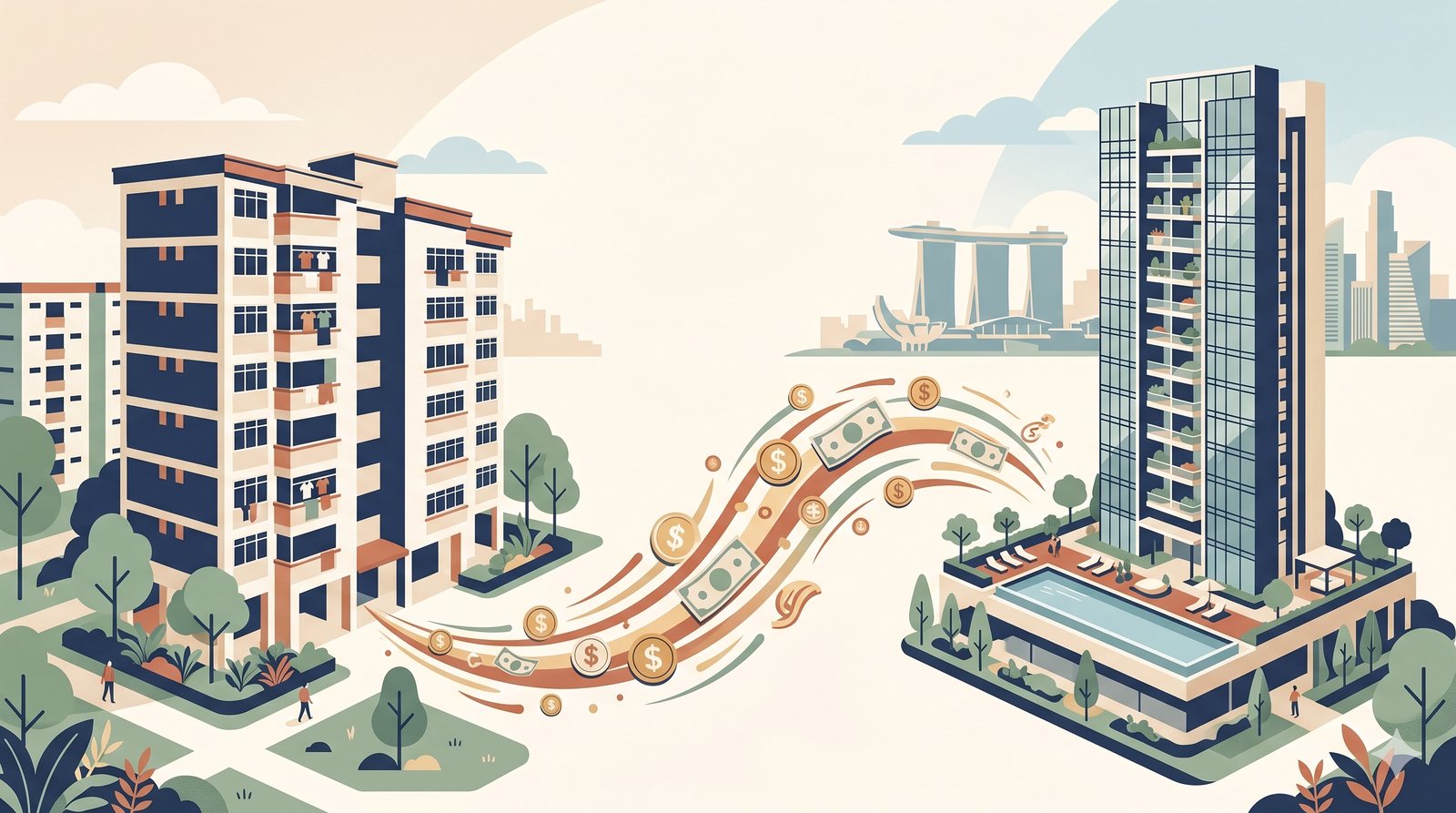
Here's the critical part most people miss: this money is not gone. It goes back into your CPF account, and you can use it again for the next property. But it is not cash in your bank — so for your downpayment, you separate the two.
There's also a cost most people forget at this stage: selling isn't free. Agent commission (typically ~2% + 9% GST ≈ $15,300 on a $700k sale) and legal fees (~$2,500) come out of your cash proceeds.
So from a flat selling at $700k, your real liquid position is roughly $342k cash + $150k CPF ≈ $492k of buying power for the downpayment — but only the cash portion spends freely.
One timing trap to know: the $150k CPF refund takes about 2–3 weeks after legal completion to land back in your OA. If you're buying and selling at the same time, that money is briefly locked — so you either time your completions carefully or arrange a bridging loan (which covers your cash proceeds, not your CPF). Don't assume it's instantly there for your condo downpayment.
(If you bought your flat a long time ago and barely used CPF, your cash portion is bigger. If you bought recently with heavy CPF usage, more of it is locked back into CPF. This is why two neighbours with identical flats can have completely different real budgets.)
Step 3: The loan ceiling — what your income actually supports
This is the half people underestimate most. On a private property your first home loan can be up to 75% of the price (LTV), with the remaining 25% from your downpayment (at least 5% must be cash; the rest can be CPF).
But LTV is only the ceiling. The real limit is TDSR — the bank caps your total monthly debt repayments at 55% of your gross monthly income, and it stress-tests your mortgage at a 4% interest rate floor, not today's actual rate. So even if you're offered 3%, the bank checks whether you could survive at 4%.
Rough rule of thumb at a 4% stress rate over a 30-year tenure: every $1,000/month of repayment supports very roughly $210,000 of loan.
Take a household income of $11,000/month:
TDSR ceiling: 55% × $11,000 = $6,050/month available for all debt
Minus any car loan / personal loans first. Say you have none.
$6,050/month → roughly a $1,267,000 loan at the 4% stress rate, 30-year tenure.
(If you have a $700/month car loan, that comes straight off the top — your mortgage headroom drops to ~$5,350, and your loan ceiling falls by close to $150k, to around $1,120,000. Debts you forgot about quietly shrink your condo.)
Step 4: Put it together — and subtract the costs
Now we combine — but watch which limit bites first.
Downpayment firepower: ~$342k cash + $150k CPF = ~$492,000
Loan ceiling (income, TDSR): $1,267,000
On a private property the loan can fund at most 75% of the price, so your loan ceiling caps the price at $1,267,000 ÷ 0.75 ≈ $1.69m. Your ~$492k downpayment firepower covers the other 25% (plus stamp duty) up to roughly the same level — so for this profile, the loan ceiling is the binding constraint, landing you just under $1.7m on paper.
But you can't spend right up to the ceiling, because Buyer's Stamp Duty (BSD) comes out of your cash. On a ~$1.6m property, BSD is roughly $49,600, plus legal fees (~$3k), and you want a renovation + emergency buffer.
Tiered BSD (residential, 2026): 1% on the first $180k, 2% on the next $180k, 3% on the next $640k, 4% on the next $500k, 5% on the next $1.5m (i.e. up to $3m), and 6% above $3m.
A timing point that catches people: BSD must be paid within 14 days of exercising the Option to Purchase — long before your HDB-sale CPF refund arrives. So you need enough cash on hand to front the stamp duty first, then reimburse yourself later.
Realistic condo ceiling after costs and a sensible buffer: around $1.6 million.
So the honest answer for this profile — $700k flat, $190k loan, $120k CPF used, $11k income, no other debt — is a condo around $1.5–1.6m, not the $700k they walked in assuming. Notice the upgrade is funded mostly by the loan their income unlocks, not by the flat's sale price — which is exactly why budgeting off the sale price gets people so badly wrong in both directions.
The five things that move your number the most
Same flat, very different budgets depending on:
- How much CPF you used — heavy CPF usage means a bigger refund locked back into CPF, less spendable cash today.
- Your outstanding loan — a larger balance eats your gross proceeds directly.
- Other debts — car loans, personal loans, even a high credit-card balance shrink your TDSR ceiling first.
- Your income mix — variable income (commission, bonus, rental) gets a 30% haircut: the bank only counts 70% of it toward TDSR. Two people earning "$11k" — one all salary, one half commission — qualify for very different loans.
- Your age and loan tenure — tenure is capped so the loan ends by age 65 for full LTV; older borrowers get a shorter tenure, which lowers the loan ceiling. If your tenure runs past 30 years or beyond age 65, LTV drops to 55% and your minimum cash downpayment rises from 5% to 10% — a meaningful extra cash hit.

Hey — quick hello, I’m Melvin
If we haven’t met: I’m Melvin Lau, a property strategist with PropNex (CEA R067207F). The cash-out math above is the exact diagnostic I run with upgraders — except I use your real CPF accrued interest, outstanding loan and income mix, so the number is one you can actually act on.
If you’re sitting on a flat past MOP and want your real number, just message me — no pitch, just the math.
WhatsApp Melvin →
So what should you actually do?
Don't budget off your sale price. Budget off the four-number chain — proceeds, CPF refund, usable cash, loan ceiling — minus costs. That's the number that tells you which launches and resale units are genuinely in reach, and which ones will quietly overstretch you.
When I sit down with an upgrader, this is the exact diagnostic I run — except I pull your actual CPF accrued interest from your statement, your actual outstanding loan, and stress-test your actual income mix, so the ceiling is real, not a rule-of-thumb. The difference between the rough number and the real one is often $100–200k in either direction — enough to change which unit you're even looking at.
If you're sitting on a flat past MOP and wondering what it can really buy, send me your numbers and I'll run the clean version for you — no pitch, just the math. Start here, or read my companion guides on HDB sale proceeds and upgrading from HDB to condo.
Figures current as at 2026: TDSR 55%, MAS stress-test floor 4%, CPF OA accrued interest 2.5% p.a. compounded, private first-loan LTV 75% (min 5% cash; 55% LTV with 10% min cash if tenure exceeds 30 years or runs past age 65), BSD residential tiers 1–5% up to $3m and 6% above. The worked example is illustrative and rounds transaction costs — your actual numbers depend on your CPF statement, outstanding loan, income mix, age and ABSD eligibility. Always confirm with your banker and a CPF refund statement before committing.
Frequently asked questions
Do I get my CPF back in cash when I sell my HDB?
No. The CPF you used — principal plus accrued interest — is refunded into your CPF Ordinary Account, not your bank account. You can use it again for your next property's downpayment, but you can't spend it as cash on renovation, furniture or fees. Only the proceeds left after clearing your loan and refunding CPF arrive as actual cash.
What is CPF accrued interest and why does it reduce my proceeds?
Accrued interest is the 2.5% per year your CPF savings would have earned had you not used them for property, compounded annually. When you sell, you must return both the CPF you withdrew and this accrued interest to your own CPF account. It doesn't disappear — but it does shift money from "spendable cash" back into "locked CPF," which is why your real cash is less than your gross proceeds.
How much can I borrow for a condo on my income?
For a first private home loan, the bank lends up to 75% of the price, but the real cap is TDSR: your total monthly debt repayments can't exceed 55% of gross monthly income, stress-tested at a 4% interest rate. As a rough guide, every $1,000/month of repayment capacity supports around $210,000 of loan over a 30-year tenure — but car loans, personal loans and variable income all reduce this.
Why isn't my condo budget just my sale price plus a loan?
Two reasons. First, part of your proceeds is locked back into CPF (the refund with accrued interest), so less of it spends like cash. Second, your loan is capped two ways — by TDSR on your income, and by the 75% LTV limit — and Buyer's Stamp Duty plus a renovation buffer come out of your cash on top. The binding limit is usually your income-based loan ceiling, not your sale price, which is why two people with the same flat but different incomes have very different budgets.
Should I sell first or buy first when upgrading?
It depends on your profile and ABSD exposure — and this is where people get badly hurt, so read carefully. Selling first frees your CPF and cash and means you buy your condo as a first property with no ABSD. Buying first secures your unit but means you're buying a second property, which triggers ABSD upfront. The ABSD "claim it back later" remission is not universal — it applies only to a married couple where at least one buyer is a Singapore Citizen, who sell their existing home within 6 months. If you're single, or a PR/foreigner couple, that ABSD is permanent — on a $1.6m condo, a single Singaporean buying a second property pays 20% ABSD = $320,000 you do not get back. For most non-married-SC upgraders, selling first is the only way to avoid a six-figure ABSD bill.
The rough math gets you a range. The real diagnostic — your actual CPF accrued interest, outstanding loan, income haircut and age-based tenure — gets you the number you can act on.
WhatsApp Melvin →