INSIGHTS · Jun 11, 2026 · 6 min read
$500,000 Before the Bank Lends You a Cent: The Real Condo Downpayment in Singapore for a $2M Home
Everyone knows the monthly instalment on a $2 million condo. Almost nobody can tell you the upfront number.
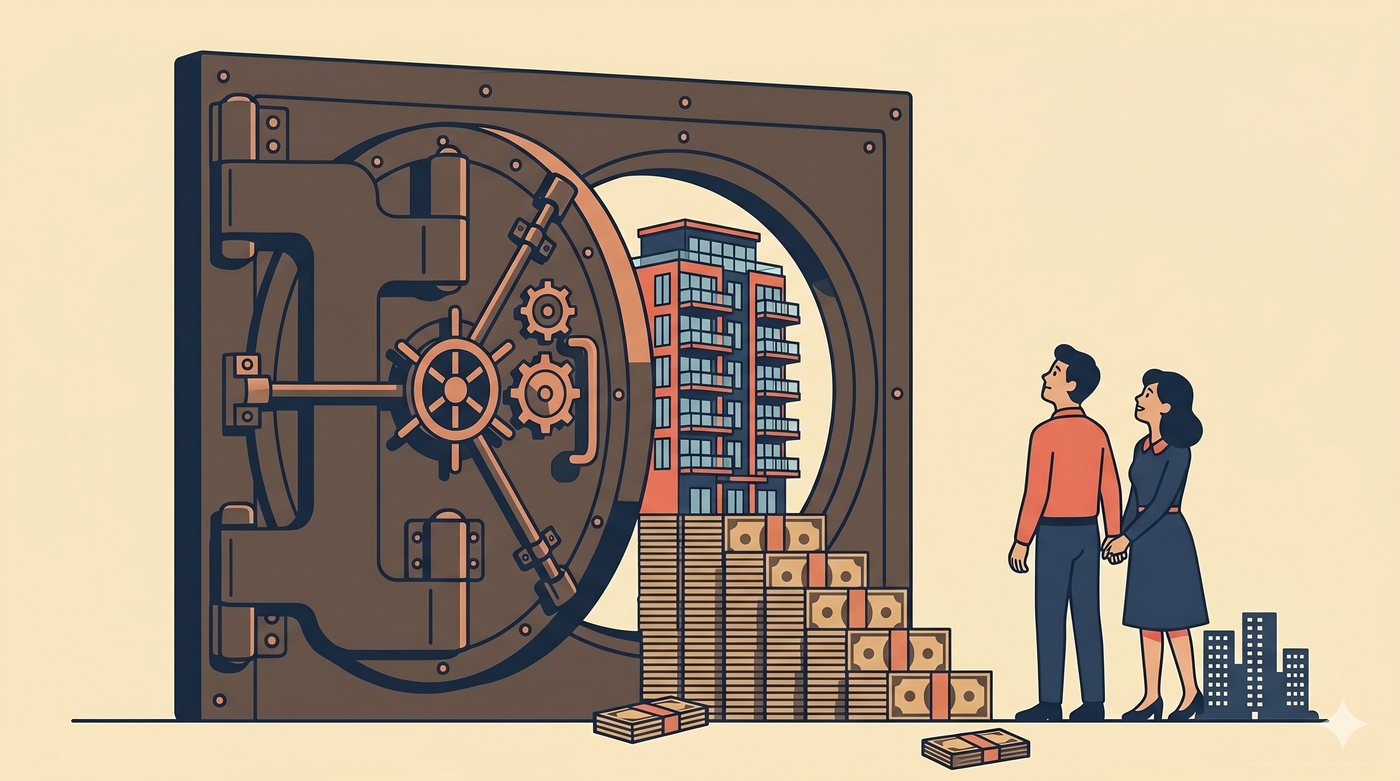
Here it is: before the bank disburses a single dollar of your housing loan, a first-time private buyer needs roughly $575,000 of their own money on the table. Half a million of it is the downpayment alone. And $100,000 of that must be hard cash — not CPF, not "I'll have it by completion." Cash.
This catches more upgraders off guard than interest rates ever do. So let's lay out the full table, line by line, and then talk about how people actually fund it.
How much do you need upfront for a $2M condo in Singapore?
Assume a first housing loan, no existing mortgage, at the maximum 75% loan-to-value (LTV). The bank funds $1.5 million. Everything else is you:
Item | Amount | Cash or CPF? |
Purchase price | $2,000,000 | — |
Bank loan (75% LTV, first loan) | $1,500,000 | Bank |
Downpayment — first 5% | $100,000 | Hard cash only |
Downpayment — next 20% | $400,000 | CPF OA and/or cash |
Buyer's Stamp Duty (BSD) | ~$69,600 | Cash or CPF (conditions apply) |
Legal/conveyancing + valuation + misc | ~$3,000–$5,000 | Cash or CPF (legal fees, conditions apply) |
Total before the loan kicks in | ~$573,000–$575,000 | Min. ~$100,000 hard cash |
On the BSD: it is tiered, not flat. For a $2M residential purchase the math runs 1% on the first $180K, 2% on the next $180K, 3% on the next $640K, 4% on the next $500K and 5% on the final $500K — $69,600 in total, payable within 14 days of exercising your option. The 6% top tier only bites above $3 million, which is cold comfort at this price point.
And remember the sequencing. For a resale unit, the 1% option fee and 4% exercise fee — your $100K cash component — leave your account weeks before completion. For a new launch, the 5% booking fee is cash on day one. The bank's $1.5 million is the last money to move, not the first.

Hey — quick hello, I’m Melvin
If we haven’t met: I’m Melvin Lau, a property strategist with PropNex (CEA R067207F). I don’t just open doors for viewings — I help homeowners sequence the big moves: when to sell, when to buy, how to upgrade or right-size without overpaying tax or getting financially stuck between two homes. Most of my work is exactly this kind of planning, done before anyone signs anything.
If any of this feels relevant to your own situation, just message me — no pitch, no obligation, happy to talk it through.
WhatsApp Melvin →Why does the 5% have to be cash?
Because MAS designed it that way. The cash component is a deliberate skin-in-the-game test: if a household cannot produce 5% in liquid savings, the regulator's view is that it should not be carrying a $1.5 million mortgage. On top of that sits the Total Debt Servicing Ratio — your total monthly debt obligations, stress-tested at a 4% interest floor, cannot exceed 55% of gross income. For a $1.5M loan over 30 years, that points to a household income in the region of $13,000 a month. The downpayment is the entry fee. TDSR is the membership test. You need to pass both.
How do normal families actually find $500,000?
Here's the part the scary table hides: most successful upgraders never had $575K sitting in a bank account. They had it sitting in two other places.
1. CPF, accumulated quietly. A couple in their late 30s who have worked since their mid-20s often hold $200K–$300K combined in their Ordinary Accounts (after setting aside what's needed). That alone can cover most of the 20% portion. The lesson for younger readers: your OA balance is downpayment fuel. Plan its use deliberately.
2. The HDB flat they already own. This is the big one. Sell a flat with $250K–$400K of equity and two things happen: cash proceeds land in your account, and your CPF (plus accrued interest) is refunded — immediately reusable for the next purchase. For most upgraders, the flat funds the condo. The skill is in the timing: sell first and you may need temporary housing; buy first and you must front 20% ABSD on the new place (remittable for married couples who sell the flat within six months, conditions apply — but that is a six-figure sum out of pocket in the meantime). This is why contract-for-contract timing, extensions of stay and bridging loans exist — a bridging loan lets the bank advance your locked-up sale proceeds for the downpayment window.
3. A realistic read of the market they're selling into. Your sale price sets your war chest. With HDB resale momentum having cooled from its peak, the difference between pricing your flat right and chasing last year's number can be the difference between a comfortable bridge and a stressful one. Know your figure before you fall in love with a showflat — you can request a free valuation report on your current home here.
A word on decoupling — one spouse buying out the other so the "freed" spouse can purchase the next property as a first-timer at 75% LTV and zero ABSD. It can work. It also involves real transaction costs, stamp duties on the part-share transfer, refinancing, and CPF refunds — and with ABSD at 20% for a citizen's second property, IRAS scrutinises artificial arrangements. Treat it as a calculated strategy with professional advice, not a TikTok hack.
Is the $2M condo worth this much friction?
That's the real question, and it isn't answered by the table — it's answered by what the asset does after you buy it. The upfront $575K is not "spent" the way rent is spent; most of it converts into equity in an appreciating asset on day one. The genuine costs are the stamp duty, the fees, and the risk of buying the wrong product at the wrong price. Buyers have become brutally rational about this — it's the same logic I unpacked in the BTO queue paradox, where families paid three times more for the asset with the better exit. If the $500K barrier feels too high, that logic also explains why executive condominiums remain the most forgiving entry point per square foot for eligible households.
The number is big. It is also knowable, plannable, and — for most dual-income upgrader households — reachable with two to three years of deliberate sequencing. The buyers who get caught out aren't the ones who lacked money. They're the ones who discovered the cash component at the option table.
Run the numbers before the showflat, not after. That's the whole game.
Figures: 75% LTV and 5% minimum cash per MAS rules for a first housing loan; BSD per IRAS rates (top tier 6% above $3M, in force since Feb 2023); ABSD 20% for Singapore citizens' second property. As at June 2026.
Frequently asked questions
How much cash do I need to buy a $2 million condo?
Minimum $100,000 in hard cash (the first 5%), plus the remaining $400,000 downpayment from CPF OA and/or cash, plus ~$69,600 BSD and ~$3,000–$5,000 in legal and miscellaneous fees. All in: roughly $575,000 before the bank's $1.5M loan disburses.
Can the 25% downpayment come fully from CPF?
No. At least 5% of the purchase price must be cash. The other 20% can be CPF OA, cash, or a mix — subject to CPF usage rules and limits.
What is the BSD on a $2M property?
About $69,600, calculated on tiered rates from 1% to 5% across the $2M price. The 6% tier applies only to the portion above $3M. It's payable within 14 days of exercising the option.
Should I sell my HDB flat before buying the condo?
Selling first avoids fronting 20% ABSD and unlocks your equity for the downpayment, but you may need an extension of stay or interim housing. Buying first preserves convenience but requires paying ABSD upfront and claiming remission later (married couples, six-month window, conditions apply). Most families bridge with sale proceeds and careful contract timing.