Insights · Jun 16, 2026 · 8 min read
Buying a Home for a School: The 1km Rule, the Real Odds, and the Timing Trap
Every year I sit with parents who've found the "perfect" home inside the 1km zone of their dream school — and a chunk of them have got the timing wrong without realising it. They focus entirely on the distance and miss the one rule that actually decides whether the plan works: the clock.
If you're thinking of moving to get your child into a specific primary school, here's how the system really works, where the 1km rule helps (and where it doesn't), and the mistake that quietly sinks the most well-planned moves.
First, what the 1km rule actually does — and doesn't do
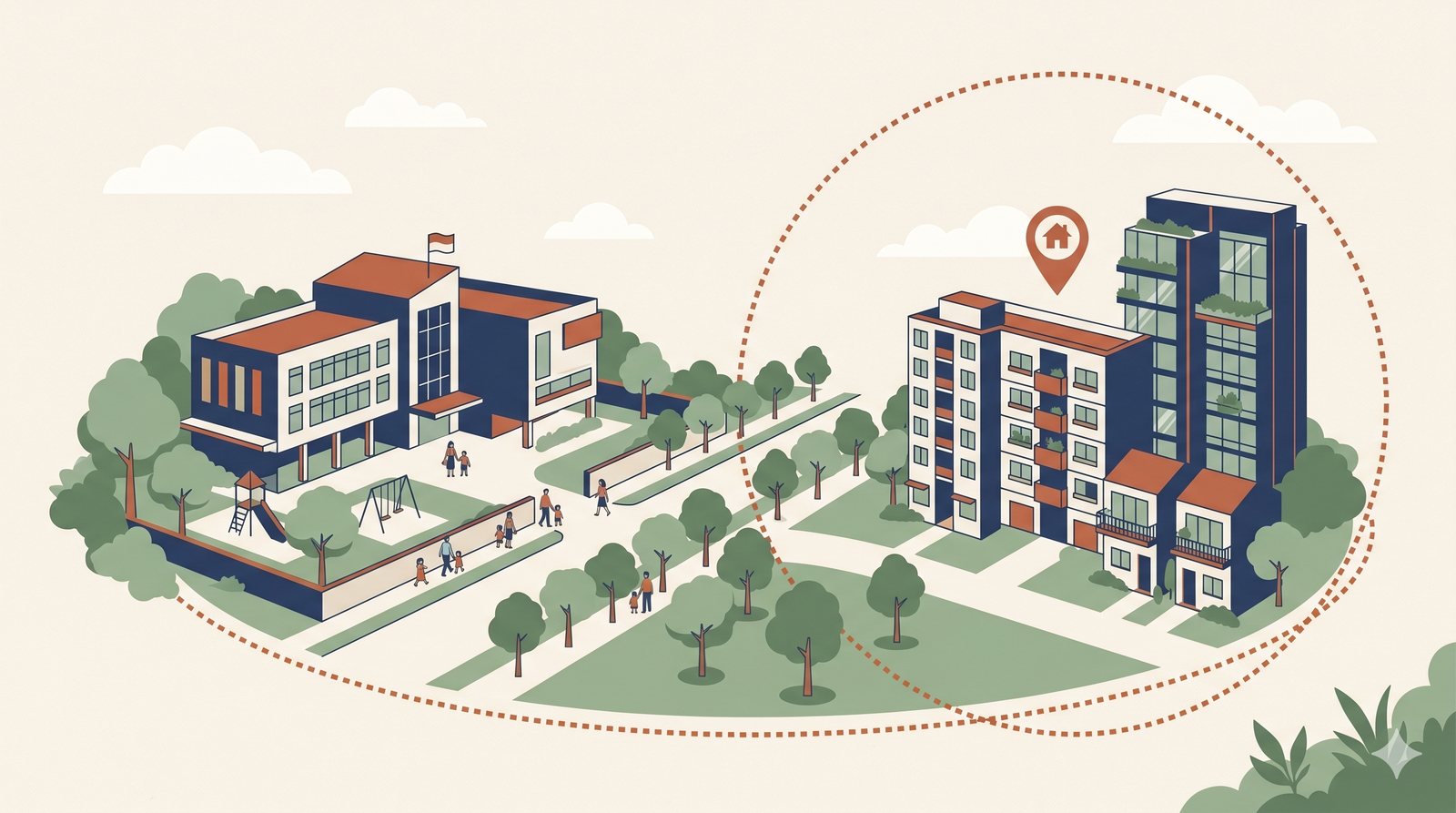
Distance does not guarantee you a place. It only changes your priority if a phase is oversubscribed and goes to balloting. If the school you want isn't oversubscribed in your phase, a child living 3km away gets in just as easily as one across the road. The 1km rule only matters when there are more applicants than seats — which, for popular schools, is exactly when it matters most.
When a phase does ballot, MOE applies this priority order strictly, in sequence:
P1 ballot priority order
Citizenship outranks distance · balloting happens only within a bracket
Two things jump out. First, citizenship outranks distance — an SC living 5km away is placed ahead of a PR living next door. Second, balloting only happens within a bracket. So if a school has 40 Phase 2C seats and 60 SC-within-1km applicants, those 60 ballot for the 40 seats and everyone further out gets nothing. Being within 1km doesn't win you a seat — it just gets you into the right queue.
The phases, in plain English
P1 registration runs in phases, and most "buy a home for the school" strategies are really about Phase 2C (and sometimes 2B), because that's where general applicants without alumni or sibling links compete — and where distance decides the ballot.
- Phase 1 — for children with a sibling already in the school. (If you have this, you barely need to think about distance.)
- Phase 2A — parent/sibling is an alumnus, parent is on staff or the school committee, or the child is in the school's MOE Kindergarten. Alumni priority is the single biggest lever.
- Phase 2B — parent volunteers (min 40 hours of service), endorsed members of an affiliated church or clan, or active community/grassroots leaders connected to the school. At least 20 places reserved.
- Phase 2C — open to everyone not yet placed. 40 places reserved. This is where the 1km battle is fought.
The strategic takeaway: if you or your spouse are an alumnus of the target school, you register in Phase 2A, which is usually far less crowded than 2C — and in that case the home address matters much less. If you have no alumni link, you're in 2C, and the 1km address becomes your main edge.
The timing trap that catches the most parents
Two rules decide whether your move actually works — and most parents only know half of one of them.
Rule 1: you can register with a home you haven't moved into yet. This surprises people. You don't need to physically live there by registration day. You can register using a resale flat or even an uncompleted new launch/BTO — provided the vacant possession (or delivery possession) date in your Sales & Purchase agreement is within 2 years of your child entering Primary 1. You register with the S&P agreement (or Agreement for Lease for HDB) as proof. So a new launch isn't automatically "too late" — it's only ruled out if its possession date falls more than 2 years away from your child's P1 entry. The 2-year possession window is the real test, not whether you've already physically moved in.
Rule 2: the 30-month stay requirement. If you gain a place through your distance category, you must then live at that registration address for at least 30 months — and this is the lock that makes it a real commitment. (When the 30-month clock starts depends on your situation: for an existing home it runs from the start of the P1 Registration Exercise; for an uncompleted property it effectively runs from when you actually move in. Confirm your exact start date with MOE for your case.)
Put the two together and the trap is clear:
- Mis-timing the possession date — for a new launch, the make-or-break number is the possession date in your S&P, not the renovation schedule. If TOP lands outside the 2-year window, the address can't be used. Check the developer's stated completion against your child's P1 year before you commit.
- Treating it as a flip — the 30-month stay means this isn't a buy-low-sell-fast move. If your plan needs you to exit within two years of moving in, the school strategy and the investment strategy are fighting each other.
- Forgetting the address has to be real — the registration address must genuinely become your home, and the stay requirement is enforced. Use an address you won't actually live in and you risk MOE transferring your child to another school at its discretion — with no say from you.

Hey — quick hello, I’m Melvin
If we haven’t met: I’m Melvin Lau, a property strategist with PropNex (CEA R067207F). School-catchment moves are some of the most time-sensitive decisions I help with — get the phase, the possession date and the 30-month clock lined up and it works; miss one and the whole plan falls over.
If you’re weighing a move for a specific school, just message me — I’ll map the timing against your child’s P1 year before you commit to anything.
WhatsApp Melvin →So how should you actually play it?
The honest decision tree I walk parents through:
- Do you (or your spouse) have an alumni link to the school? If yes, you're likely in Phase 2A — register there, and the 1km address matters far less. Don't overpay for distance you may not need.
- No alumni link, popular school? You're in 2C, balloting is likely, and a genuine within-1km address is your real edge. Now the timing is everything — line up your purchase so the address is valid at registration (possession within 2 years), and make sure you can commit to the 30-month stay that follows.
- Is the school actually oversubscribed? Some good schools clear in 2C without balloting. If so, you may not need to move at all — and certainly not lock yourself into a 30-month hold. Check the prior years' phase data before you buy.
- Check the possession date, not just the property type. Resale lets you move in fast. A new launch or BTO can still work — if its possession date falls within 2 years of your child's P1 entry — but if completion runs later than that, the address simply can't be used. Confirm the possession date in the S&P against your child's P1 year before you commit.
That's the point I care most about as a strategist: the best home for a school catchment and the best home for your money aren't always the same property — and between the 2-year possession window and the 30-month stay, the timing forces you to choose deliberately, not by accident.
If you're mapping a move for a school, the financing side matters too — see my guide on how much condo your HDB can actually buy so the school plan and the budget line up.
Rules current as at 2026, per MOE's Primary One Registration framework. The phase structure, distance-priority order, the 2-year possession-date allowance for uncompleted properties, and the 30-month stay requirement are set by MOE and can change — always confirm the latest on the MOE P1 registration site, and your own exact 30-month start date, before committing to a property. School oversubscription varies year to year; check the specific school's prior phase data.
Frequently asked questions
Does living within 1km guarantee my child a place?
No. Distance only gives you priority if the phase is oversubscribed and goes to balloting. If the school isn't oversubscribed, distance makes no difference. And even within 1km, if there are more applicants than seats in your citizenship bracket, you still have to ballot — being within 1km gets you into the right queue, not past it.
How does the priority order work between citizens, PRs and distance?
MOE applies a strict sequence: Singapore Citizens within 1km, then SCs 1–2km, then SCs beyond 2km, then PRs within 1km, then PRs 1–2km, then PRs beyond 2km. Citizenship is ranked above distance — so a Singapore Citizen living far away is placed ahead of a PR living within 1km. Balloting only happens within a single bracket when it's oversubscribed.
What is the 30-month residency rule?
If you gain a place through your distance priority, you must live at the registration address for at least 30 months. The exact start date depends on your situation (for an existing home it runs from the start of the P1 Registration Exercise; for an uncompleted property, from when you move in), so confirm yours with MOE. The key point: it's a multi-year commitment, not a short-term play. If you don't meet it, MOE may transfer your child to another school at its sole discretion — you won't get a say in which one.
Do I have to have physically moved in before I register?
No — and this is the part most people get wrong. You can register using a resale flat or even an uncompleted new launch or BTO, as long as the vacant/delivery possession date in your Sales & Purchase agreement (or Agreement for Lease for HDB) is within 2 years of your child entering Primary 1. You register with that agreement as proof of the future address. So a new launch isn't automatically too late; it only fails the test if its possession date falls more than 2 years away from the P1 entry year.
Is alumni priority better than buying within 1km?
Usually, yes. If you or your spouse is an alumnus, you register in Phase 2A, which is typically far less crowded than the open Phase 2C — so you may not need a 1km address at all. Buying within 1km is mainly the strategy for parents with no alumni, volunteer or sibling link, who are competing in 2C.
The move only works if the timing, the phase and the property type all line up. That's the exact map I build with parents — which school, which phase, and which home actually fits the 30-month clock.
WhatsApp Melvin →