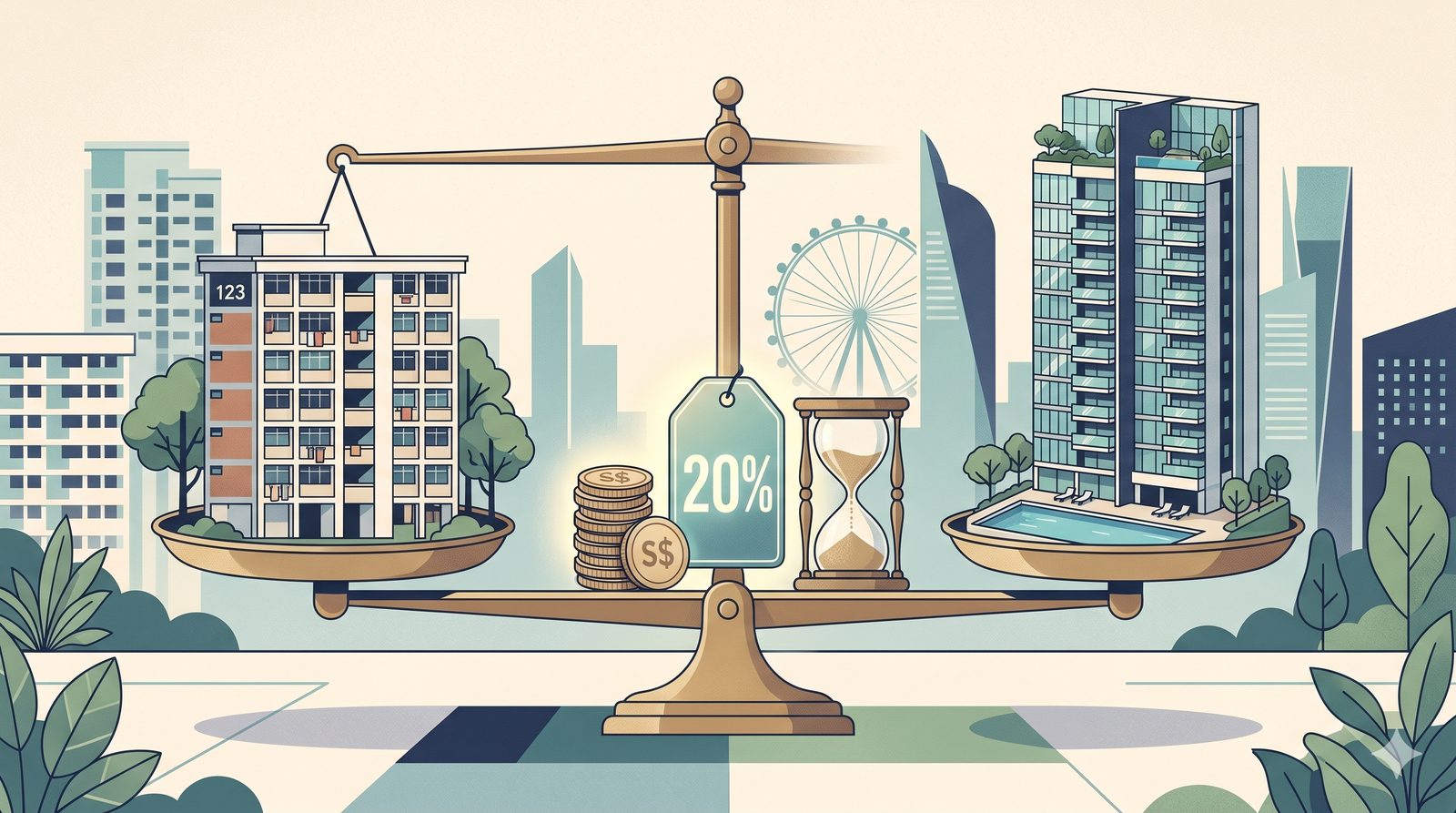
A couple sat across from me last month, mid-40s, holding a fully paid 4-room flat and a dream of a condo with a pool. Their first question wasn’t about the condo. It was: “Melvin, is it true we have to pay an extra 20% tax just to upgrade? That’s $300,000 on a $1.5M condo. There’s no way.”
There is a way. But it’s not a loophole, and the word “avoid” gets people into trouble. So let me give you the honest version — the one that keeps your money and keeps you out of an IRAS audit.
First, what is ABSD actually charging you?
Additional Buyer’s Stamp Duty is a surcharge on top of the normal Buyer’s Stamp Duty, and it scales with how many residential properties you already own. As at June 2026, for a Singapore Citizen:
| Property you’re buying | ABSD rate (Singapore Citizen) |
|---|---|
| 1st residential property | 0% |
| 2nd residential property | 20% |
| 3rd and subsequent | 30% |
(For reference: Permanent Residents pay 5% / 30% / 35%, and foreigners pay a flat 60% on any residential purchase. These rates have been unchanged since 27 April 2023.)
Here’s the trap most upgraders walk into. The moment you buy that $1.5M condo while still owning your HDB flat, the condo counts as your second property — and you’re hit with 20% ABSD. That’s $300,000, payable within 14 days of exercising the Option to Purchase. On a flat-to-condo upgrade, that single number is often the difference between “we can do this” and “we can’t.”
ABSD isn’t a tax on owning a condo. It’s a tax on owning two properties at the same time. Almost everything about avoiding it comes down to one thing: timing.

Hey — quick hello, I’m Melvin
If we haven’t met: I’m Melvin Lau, a property strategist with PropNex (CEA R067207F). I don’t just open doors for viewings — I help homeowners sequence the big moves: when to sell, when to buy, how to upgrade or right-size without overpaying tax or getting financially stuck between two homes. Most of my work is exactly this kind of planning, done before anyone signs anything.
If any of this feels relevant to your own situation, just message me — no pitch, no obligation, happy to talk it through.
WhatsApp Melvin →So how do you legally not pay it?
There are two clean, legitimate routes. Neither is a trick. Both come down to making sure you don’t own two homes at the moment of purchase — or that you don’t own them for long.
Route 1 — Sell first, then buy
This is the only route where you genuinely never pay ABSD at all.
If you sell your HDB flat before you commit to buying the condo, then at the point of purchase you own zero residential properties. The condo is your first property. ABSD rate: 0%. Nothing to pay, nothing to claim back.
For this to count, the sale has to be legally executed — your buyer must have exercised the OTP on your flat (or HDB approved the resale) — before you exercise the OTP on the condo. A handshake or “we’re about to sell” doesn’t make you a zero-property owner in IRAS’s eyes.
The cost of this route isn’t money — it’s logistics and nerve:
- You may need temporary accommodation between selling and buying (renting, or moving in with family).
- You’re buying in whatever market exists after you’ve sold, with the clock ticking.
- You lose a little negotiating calm, because you’re now a buyer who needs a home.
For couples who are disciplined, have somewhere to stay, and don’t want to front a six-figure tax, this is the cleanest path. No IRAS application, no refund to chase.
Route 2 — Buy first, then claim the married-couple remission
This is the route most HDB upgraders actually use, because selling-then-living-out-of-a-suitcase isn’t realistic with kids and a job.
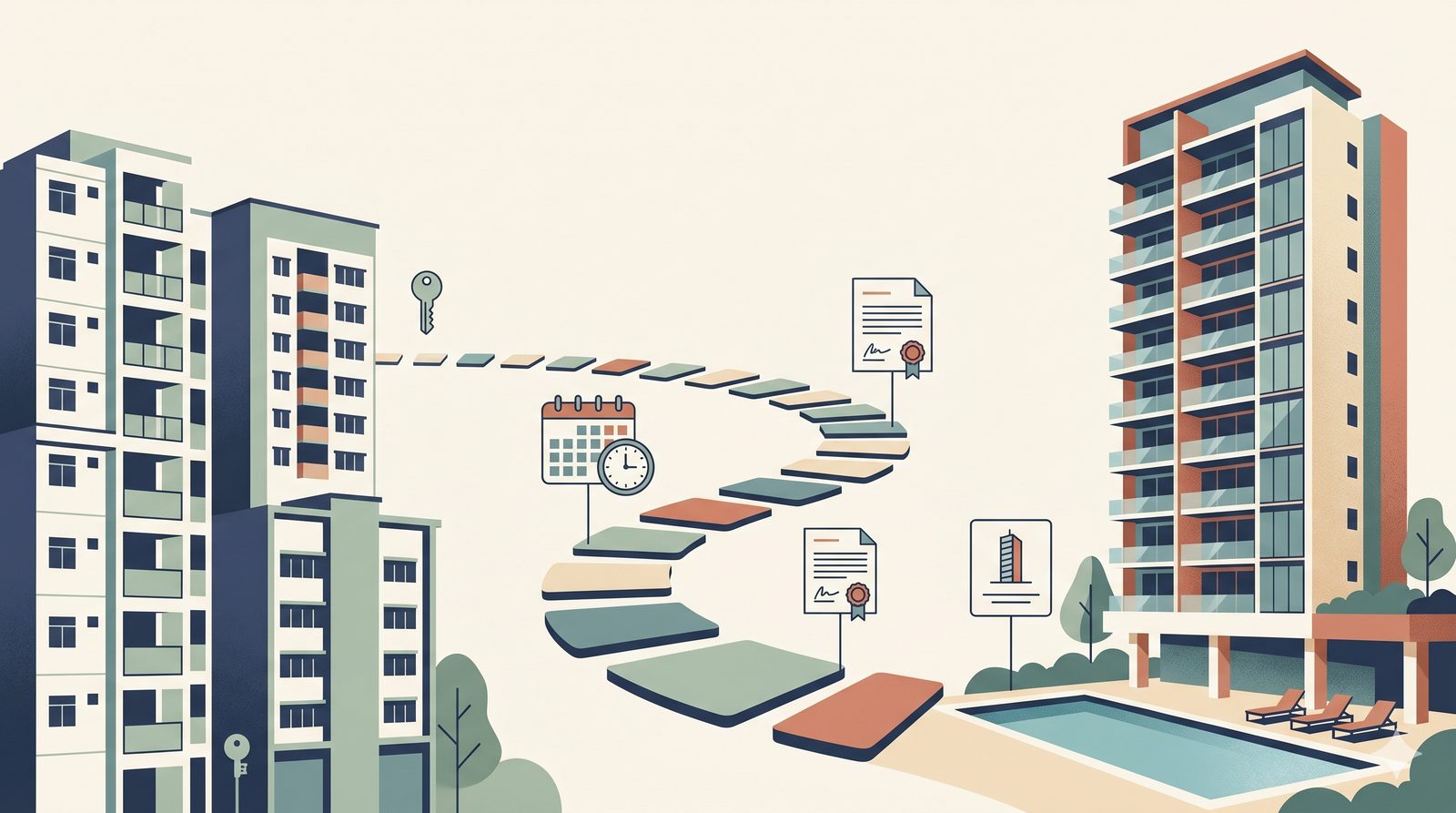
Here, you buy the condo first, while still owning the flat. You pay the 20% ABSD upfront — yes, the full $300,000. But if you qualify, you then apply to IRAS for a full refund (remission) once you sell the flat.
To qualify for the married-couple remission, all of these must be true:
- The property is bought by a married couple, with at least one spouse a Singapore Citizen.
- The condo is purchased in both spouses’ names only (no third party, no child on the title).
- At the time of purchase, neither spouse owns any other residential property — apart from the one you’re about to sell.
- You sell your first property within 6 months of the date of purchase of the second property — that’s the date you exercise the Option to Purchase (or sign the Sale & Purchase Agreement), not the date you collect keys or legally complete. (For a property still under construction, the window runs from the issue of the TOP or CSC, whichever is earlier.)
Hit all four and IRAS refunds the entire ABSD. Miss the deadline and you forfeit the refund — the $300,000 is gone. That window is the single most important date in your whole upgrade, and it’s where I see people get hurt: they assume the clock starts when they move in. It doesn’t. It starts the day you commit to the condo — so the sale of your flat has to be well underway before you sign.
I’ve written before about why timing your upgrade is the whole game — this remission window is exactly why.
“What about decoupling? Or that 99-1 thing I read about?”
This is where I have to be the un-fun one — because two strategies people bring up are either banned or illegal for an HDB upgrader, and I’d rather you hear it from me than from IRAS.
Decoupling an HDB flat is not allowed. Since April 2016, HDB has prohibited married couples from transferring ownership shares between spouses (part-sale or gifting) — the exact move “decoupling” relies on. The only exceptions are specific hardship situations like death, divorce, or genuine financial distress. So if you own an HDB flat, you simply cannot decouple it to free up a name for a second property. Full stop. (Decoupling is still possible for private property — which is one reason some upgraders move from HDB into a condo first, then decouple the condo down the line to plan a future second purchase. That’s a separate, longer-term strategy, not a way to dodge ABSD on this upgrade.)
The “99-to-1” arrangement is a tax-avoidance scheme IRAS is actively prosecuting — and it doesn’t work the way most people think. The illegal version: the spouse with the lower ABSD profile buys 100% of the property first (paying little or no ABSD), then within days sells a 1% share to the higher-profile spouse, so ABSD is only charged on that 1%. IRAS has audited these, recovered the full unpaid duty, and added a 50% surcharge on top — clawing back around $60 million across 166 flagged cases, with criminal prosecution in some. A “saving” of a few hundred thousand is not worth that. I won’t structure one, and you should walk away from anyone who offers to.
If your goal is simply to upgrade from a flat to a condo, you need neither. Routes 1 and 2 above are cleaner, cheaper, and completely legal.
The number that actually decides this
People obsess over the 20%. The real question is whether you can carry the bridge — can you afford to pay the ABSD upfront (Route 2) and wait for the refund, or do you need to sell first (Route 1) and live with the logistics?
That depends on three figures: how much cash and CPF you can free up, what your flat will realistically sell for and how fast, and whether your income and loan eligibility support the new mortgage before the old place is sold. Get those three numbers right and the ABSD stops being a wall and becomes a cash-flow timing exercise. Get them wrong and you either overpay tax or get stuck owning two homes you can’t comfortably service.
This is the part I do with clients before anyone signs anything — map the sequence, the dates, and the cash flow so the 6-month window is a plan, not a panic. You can get a free valuation of your current flat here to start with a real number instead of a hopeful one.
You don’t avoid ABSD with a clever trick. You avoid it by sequencing your move properly — and that’s a plan you can make today, with the deadlines working for you instead of against you.
Figures as at June 2026, per IRAS. ABSD rates, remission conditions and timelines are set by IRAS and can change — confirm current rules at iras.gov.sg or with your conveyancing lawyer before acting.
Frequently asked questions
Can I really avoid ABSD when upgrading to a condo?
You can legally avoid paying it in two ways: sell your existing home before buying the new one (so the new property counts as your first — 0% ABSD), or, for a married couple with at least one Singapore Citizen, buy first, pay the 20% ABSD, then claim a full refund by selling your old home within 6 months. There’s no legal way to simply not pay while owning two homes indefinitely.
How much is ABSD on a second property in Singapore?
For a Singapore Citizen, ABSD on a second residential property is 20% of the purchase price or market value, whichever is higher, as at June 2026. On a $1.5 million condo that’s $300,000, payable within 14 days of exercising the Option to Purchase.
What is the ABSD remission deadline for married couples?
You must sell your first residential property within 6 months of buying the second property (if completed), or within 6 months of the TOP/CSC date if it’s under construction. Miss this window and the ABSD refund is forfeited.
Can I decouple my HDB flat to avoid ABSD?
No. Since April 2016, HDB has banned married couples from decoupling (transferring ownership between spouses) to buy a second property, except in hardship cases like death or divorce. Decoupling remains possible for private property, but it is not an option for an HDB-to-condo upgrade.
Is the “99-to-1” arrangement a safe way to avoid ABSD?
No — IRAS treats it as illegal tax avoidance. The scheme (one spouse buys 100%, then sells a 1% share to the higher-ABSD spouse) has been audited and clawed back, with the full duty recovered plus a 50% surcharge and prosecution in some cases. Do not use it.
Should I sell my HDB first or buy the condo first?
It depends on your cash flow. Selling first means 0% ABSD and no refund to chase, but you may need interim housing. Buying first lets you move once, but you must front the 20% ABSD and sell within 6 months to get it back. Mapping your cash, sale price and loan eligibility decides which is right.
The first conversation is complimentary — clear numbers, the right sequence, no hard selling.
WhatsApp Melvin →
Hi, I'm Melvin
Property strategist with PropNex (CEA R067207F). I help Singapore families work out when to sell, when to buy and how to sequence the big moves, with clear numbers and no pressure. The first conversation is free.
WhatsApp Melvin