INSIGHTS · Jun 11, 2026 · 7 min read
The 1km School Rule Just Got Stronger: How MOE's Change Affects Property
Singapore's birth cohort is shrinking. Primary school places are being cut. So the 1km rule should matter less now, right?
Backwards. Completely backwards. And the parents reading it backwards are the ones who'll be balloting from outside the circle in three years' time.
Let me walk you through the hidden mechanic — what MOE actually changed in 2026, why it makes the 1km radius around the right schools more valuable, and what that means if you're buying property with a primary school in mind.
What did MOE actually change in 2026?
As at the 2026 Primary One Registration Exercise (for the 2027 intake), MOE began gradually reducing P1 intake across the majority of primary schools, citing significantly smaller cohorts arriving from 2027 onward. The published numbers: 61 schools had their intake cut, 12 increased, 106 unchanged — a net reduction of roughly 1,460 P1 places in a single exercise. MOE has said openly that the goal is to trim capacity in step with demand precisely to avoid large-scale school mergers and keep schools geographically spread.
Read that carefully. The system is not letting places sit empty so everyone gets in easily. It is shrinking supply to match shrinking demand — school by school, year by year.
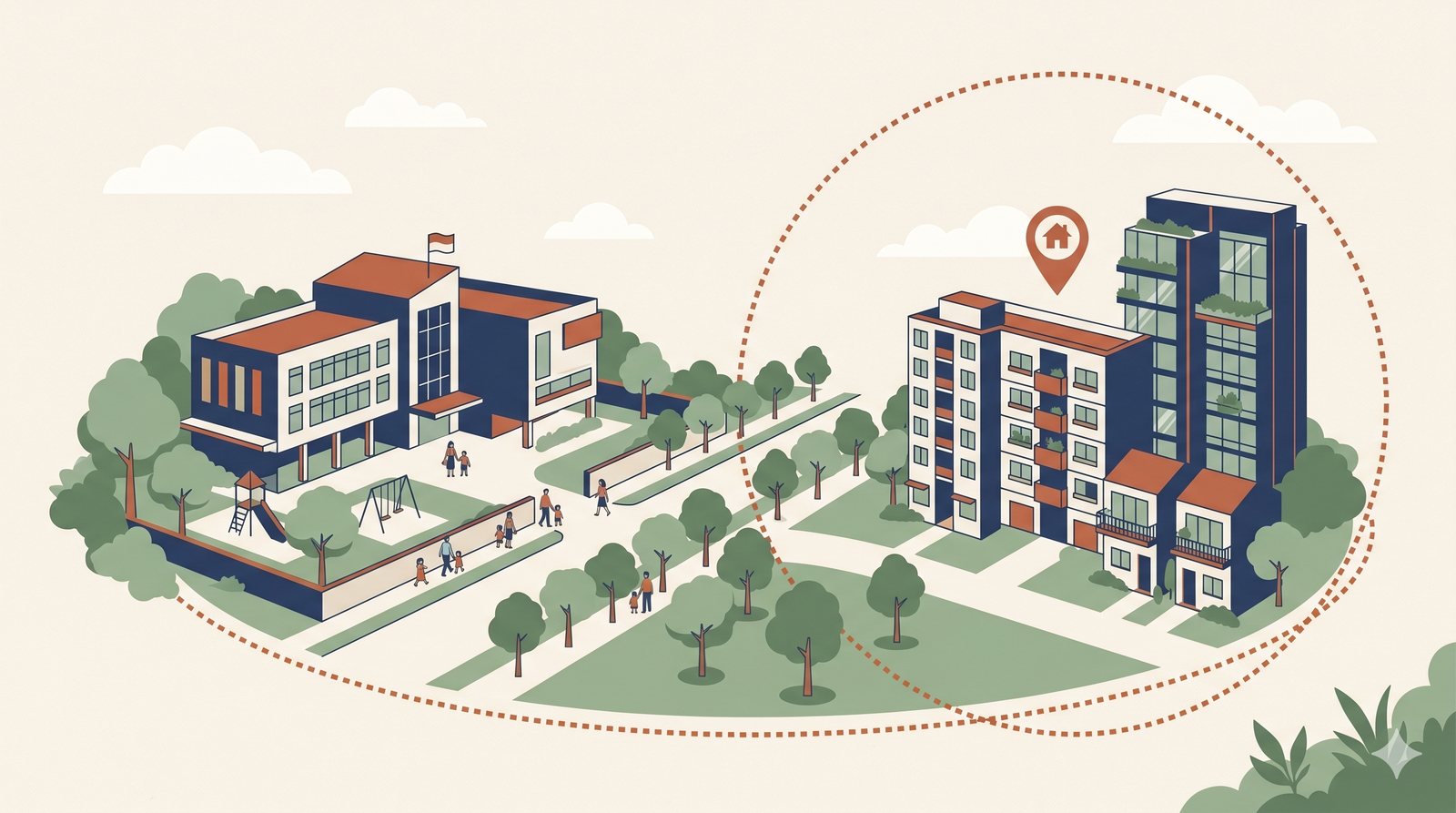
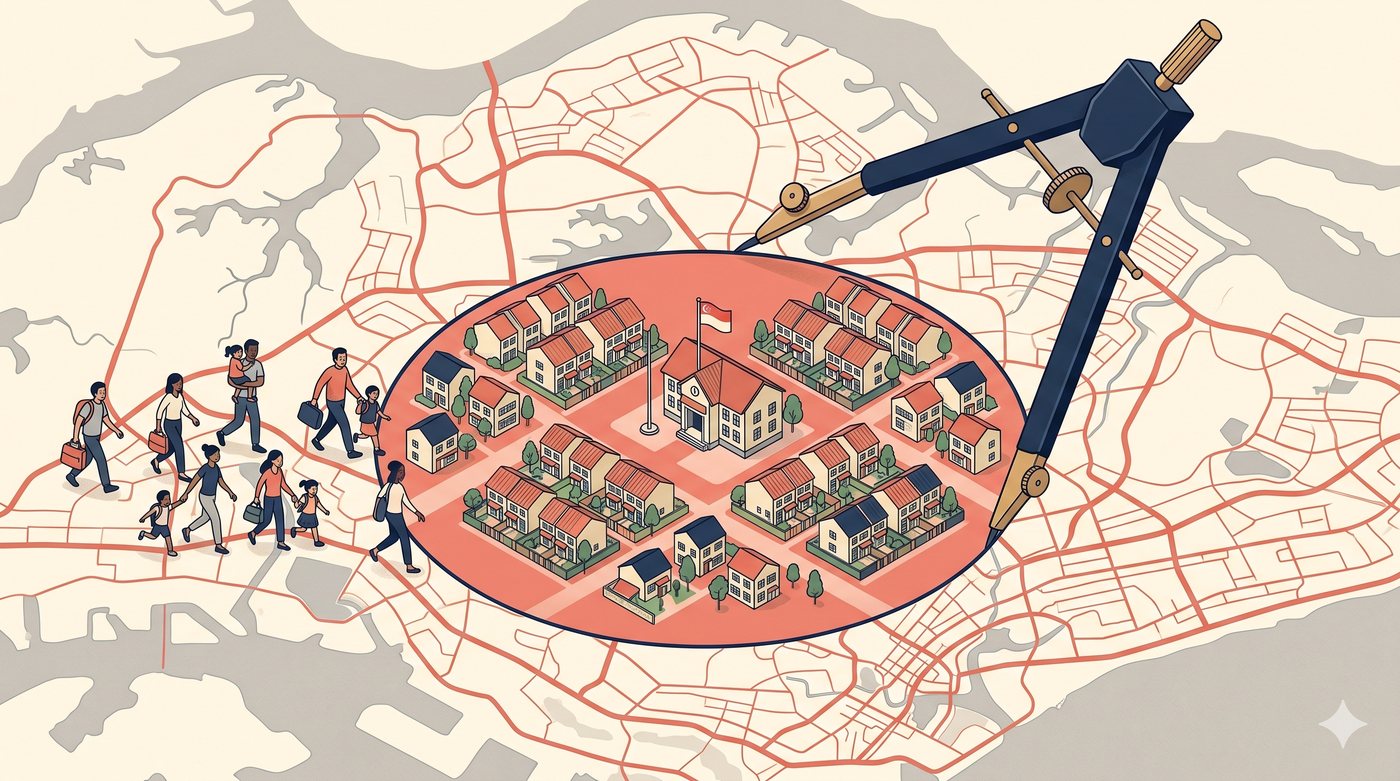
Registration for the current exercise runs 30 June to 30 October 2026. The mechanics of priority remain: within Phase 2C, citizenship first, then distance — home-to-school under 1km, then 1–2km, then beyond 2km — with balloting conducted within whichever band oversubscribes. And the address only counts if your family has lived there for at least 30 continuous months.

Hey — quick hello, I’m Melvin
If we haven’t met: I’m Melvin Lau, a property strategist with PropNex (CEA R067207F). I don’t just open doors for viewings — I help homeowners sequence the big moves: when to sell, when to buy, how to upgrade or right-size without overpaying tax or getting financially stuck between two homes. Most of my work is exactly this kind of planning, done before anyone signs anything.
If any of this feels relevant to your own situation, just message me — no pitch, no obligation, happy to talk it through.
WhatsApp Melvin →Why does a shrinking cohort make the 1km radius MORE valuable?
Here's the mechanic most parents miss. They reason: fewer kids, less competition, so I can relax. That logic would hold if school capacity stayed fixed. It hasn't. Capacity is falling with the cohort.
Meanwhile, demand doesn't shrink evenly. Parents don't spread themselves across all 179 primary schools. They concentrate — on the same few dozen brand-name, persistently oversubscribed schools. When the cohort shrinks 10% but a popular school's intake also shrinks, the queue at that school barely shortens. The schools that empty out are the ones that were never balloting anyway.
The result, as at 2026:
- At popular schools, Phase 2C oversubscription persists — and with fewer total vacancies, balloting now bites earlier and harder, sometimes even within the under-1km group.
- Phase 2C Supplementary — the safety net — is thinning, because schools with cut intakes have fewer leftover places after 2C.
- The 1km band has shifted from "advantage" to "minimum ticket to enter the ballot" at the hottest schools.
This is what I mean by parents reading it backwards. The ones waiting for balloting reform or demographic decline to rescue them are betting against a system explicitly engineered to keep popular schools full. The 1km radius isn't being diluted. It's being concentrated.
What does this mean for property near primary schools?
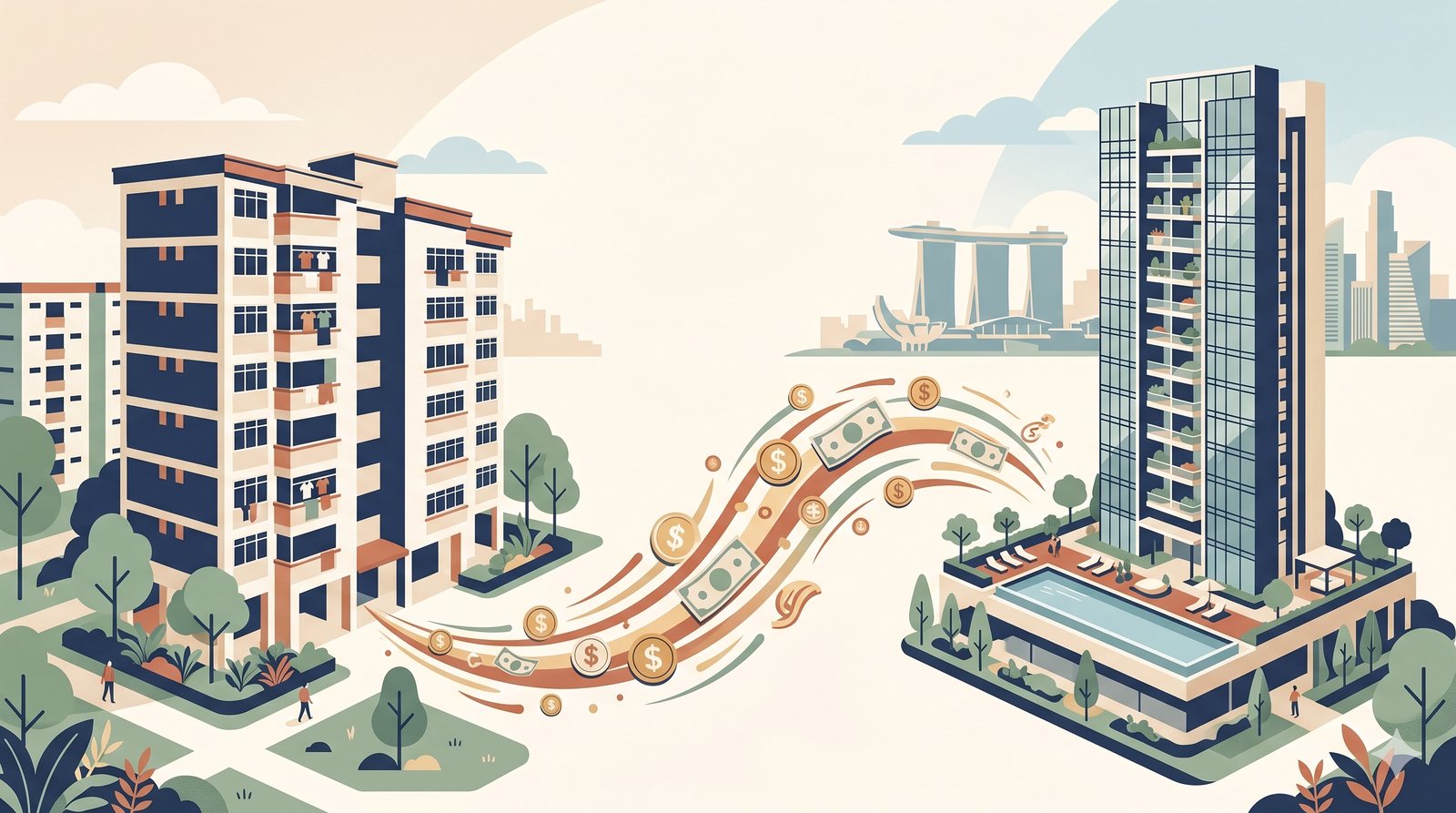
Property markets price regulatory advantages — and the 1km rule is one of the cleanest in Singapore. A flat or condo inside the radius of a consistently oversubscribed school carries a benefit that cannot be built, renovated or negotiated into existence anywhere else. That's a structural premium, not a cosmetic one.
Three features make it durable:
- It renews itself. Every year, a fresh cohort of parents with 3-year-olds needs an address inside the same circle. Your future buyer pool regenerates annually — unlike, say, a renovation premium that depreciates the day you complete it.
- The 30-month rule forces early buying. Families must be in place roughly three years before P1. That creates predictable, time-pressured demand — these buyers can't wait out a soft market the way investors can. It's the same buyer-urgency mechanic I unpacked in the BTO queue paradox: when the clock is structural, buyers move.
- MOE's tightening amplifies it. Every intake cut at a hot school raises the value of guaranteed-priority addresses around it. Scarcity upstream, premium downstream.
One caveat that keeps this honest: the premium attaches to persistently oversubscribed schools — the ones that ballot in Phase 2C year after year — not to "any school within 1km". Most Singapore homes are within 1km of some primary school. That alone is worth nothing. Check the school's actual balloting history over several years before you pay a cent extra.
Who should pay the 1km premium — and who shouldn't?
Worth paying if:
- You have a child aged 0–4 and a target school. The premium buys a real, usable entitlement — priority you'd otherwise gamble for. Work backwards from P1: move in by age 3½ to clear the 30-month bar comfortably. (Plan the purchase against the HDB resale timeline — completion dates and the 30-month clock are less forgiving than people assume.)
- You'll hold 8–10 years. You consume the school benefit, then sell to the next wave of parents who want exactly what you wanted. You use the premium and recover it.
- You're an upgrader choosing between two comparable homes. If the inside-1km option costs only marginally more, the embedded option is one of the cheapest forms of insurance in Singapore property.
Think twice if:
- You have no school-age plans. You'd be paying for an entitlement you'll never exercise, hoping resale demand alone justifies it. It often does — but you're now making a pure demographic bet in a country with a shrinking birth rate.
- The school rarely ballots. No oversubscription, no scarcity, no premium worth paying. Save the money.
- The premium breaks your TDSR comfort. No school is worth a stretched mortgage. A child's education is funded by a stable household balance sheet first, an address second.
- You're banking on the rule never changing. Policy evolves. As at 2026 the direction of travel has strengthened the 1km mechanic — but a buyer relying on it for the next 20 years is taking duration risk on a regulation.
The strategic read
MOE's 2026 move is rational policy: shrink capacity gently, avoid painful mergers, keep schools everywhere. But its property side-effect is unambiguous. Fewer places at the schools everyone wants, plus untouched priority mechanics, equals a stronger — not weaker — 1km rule.
The parents who win this game are the ones who plan it like a property strategy: pick the school early, verify its balloting history, buy inside the circle three years out, and choose a unit that the next cohort of parents will fight over. If you want to know what homes inside your target school's radius are actually worth — and whether the premium there is justified by the ballot data — start with a free valuation report and we'll look at the numbers together.
Education over selling. In this case, quite literally.
FAQ: the 1km rule and property
Does living within 1km of a primary school guarantee a place?
No. Under-1km gives the highest distance priority within your citizenship group in Phase 2C, but if that group alone oversubscribes, balloting happens among under-1km applicants. At the hottest schools, 1km is the ticket into the ballot — not a guaranteed win.
How long must I live at the address before P1 registration?
As at 2026: at least 30 continuous months at the address by the start of the registration exercise. Practically, buy and move in by the time your child is around 3 to 3½.
Do homes near good primary schools really cost more?
Inside the 1km radius of consistently oversubscribed schools, yes — the radius confers a regulatory advantage that can't be replicated, and a fresh cohort of parent-buyers renews demand every year. Near schools that never ballot, the "school premium" is mostly marketing.
Will shrinking cohorts make the 1km rule irrelevant?
At popular schools, the opposite. MOE cut a net ~1,460 P1 places in the 2026 exercise so capacity falls in step with the cohort. Oversubscription at brand-name schools persists, and the 1km band remains the binding filter. The rule only weakens where it never mattered.