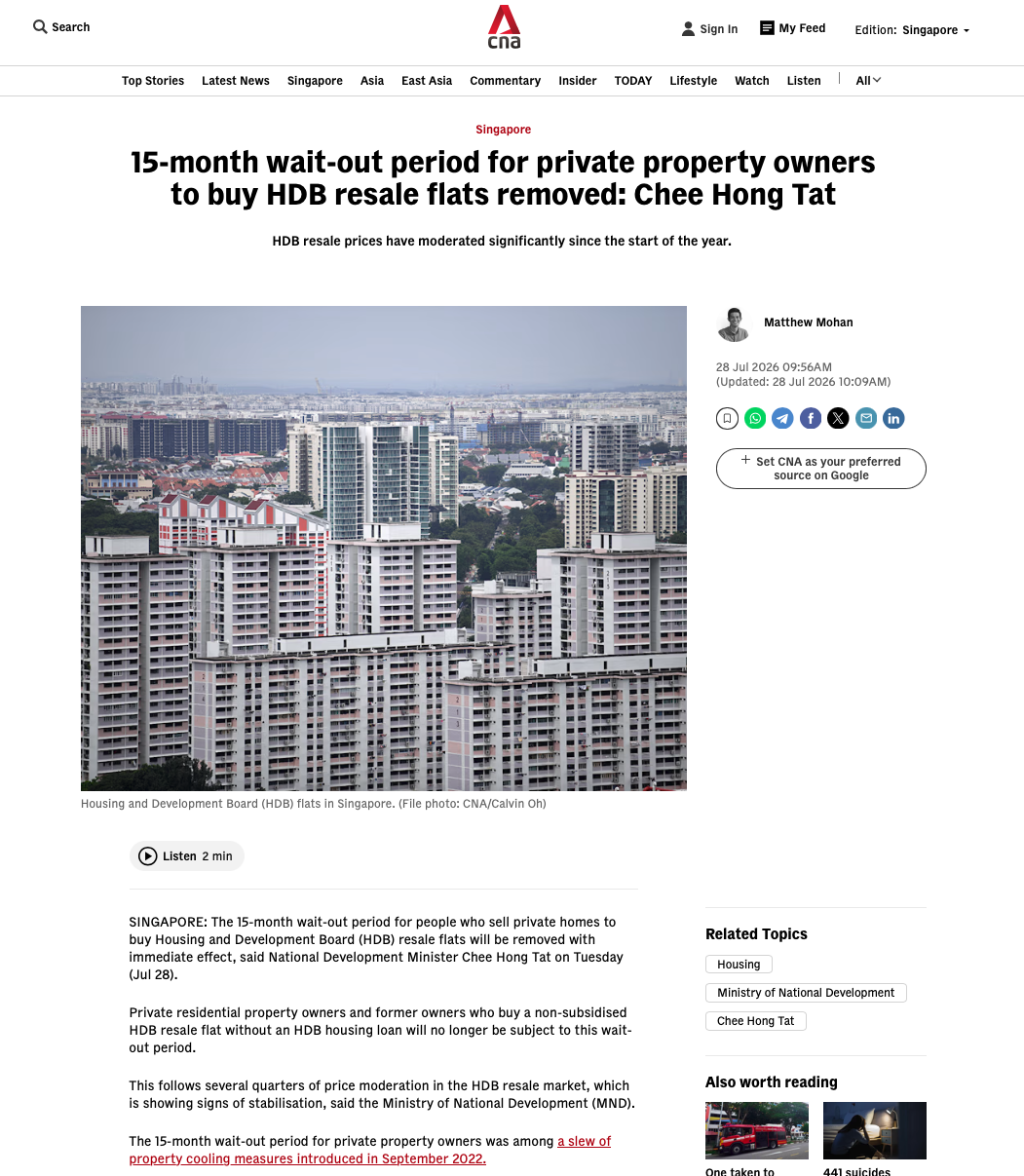
This morning, MND removed the 15-month wait-out period for private property owners buying HDB resale flats — effective immediately. Most people will read this as a headline. It is better read as an instrument panel: the government only opens a demand tap when it is confident the market underneath has stabilised. Q2 2026's data, published four days ago, tells you exactly why they moved today.
Removed with immediate effect (28 Jul 2026). Private residential property owners and former owners who buy a non-subsidised HDB resale flat without an HDB housing loan are no longer subject to the 15-month wait-out period.
It was always labelled temporary. Introduced in September 2022 as part of the cooling-measures package, the wait-out was designed to moderate resale demand and prioritise households with more urgent housing needs, like first-time buyers.
The stated trigger: stabilisation. MND cited "several quarters of price moderation in the HDB resale market, which is showing signs of stabilisation."
The appeal queue is disbanded. HDB processed about 1,800 appeals a year to waive the wait-out, approving roughly one in four. Pending appellants no longer need to wait for a reply — they can apply for an HDB Flat Eligibility (HFE) letter directly, and HDB will contact them.
The wait-out period was never about supply. It did not build a single flat. It was a demand-side valve — it took one specific buyer group (cash-rich ex-private owners) and parked them on the sidelines for 15 months so they would not compete with first-timers in the resale market.
That gives you the reading key. A demand valve only gets opened when the authority holding it believes the segment it protects no longer needs protection. MND said it plainly: several quarters of moderation, signs of stabilisation. This is not a stimulus. It is an all-clear.
And the timing is the tell. URA and HDB's Q2 2026 flash data landed on 24 July. The removal was announced on 28 July — four days later. Read the two together and the mechanism is visible:
Resale prices are running hot. The 15-month wait-out sidesteps ex-private owners out of the resale pool to protect first-timers.
Resale price growth grinds down across successive quarters. The index peaks at 203.7 in Q3 2025, then rolls over.
HDB resale dips −0.3% — a second consecutive marginal decline. The index sits ~0.4% below its peak. Volume, though, stays healthy: 6,396 flats, up 1.8%.
Prices moderating, volumes stable, supply rising. MND removes the wait-out entirely — and disbands the 1,800-a-year appeal queue behind it.
Notice what the government did not touch: the other September 2022 measures stay in place. This was surgical. They released exactly one buyer group, into exactly one segment, at exactly the moment that segment posted back-to-back quarterly declines. That is what a data-anchored policy move looks like — and it is the same discipline worth applying to your own move.
Overlay the policy change onto the quarter's actuals and you get a market that is moderating in price but deepening in activity — precisely the conditions under which releasing pent-up demand is safe. The board:
Three of those numbers matter more than the rest. 491 million-dollar flats tells you the top of the resale market was already liquid before today's news. 364 fresh MOP flats tells you new supply is arriving to meet whatever demand gets released. And 6,396 transactions on falling prices tells you this is a market clearing on realism, not freezing in fear. That is the exact profile a policymaker wants to see before removing a guardrail.
Sold your private home and were serving — or facing — 15 months of dead time? That cost just went to zero. The sequence sell-then-buy compresses into one continuous move, with no interim rental, no appeal letter, no HDB loan dependency. For households right-sizing out of a non-landed segment that dipped −0.1% this quarter, the exit and the entry can now be timed together.
A cohort of equity-heavy, cash-ready buyers just re-entered your market with immediate effect — and they were already transacting through the appeal lane at ~1,800 applications a year. With million-dollar resale flats at a record 491 in Q2, larger and well-located flats are where this released demand will concentrate first.
Yes, you now share the resale pool with cash-rich downgraders — the original reason the rule existed. The offset: supply is swelling from below. Fresh MOP flats rose to 5.9% of Q2 sales, more flats hit their five-year mark through 2026, and PropNex projects 26,000–27,000 resales with prices broadly stable (≤ +1%). Your edge is preparation, not patience.
MND called the 2022 measure temporary — and today proved it. Removing a cooling measure the moment the data justifies it does two things: it recycles demand into a segment that can absorb it, and it tells every future market participant that guardrails respond to gauges, not to pressure. Watch the other September 2022 measures for the same pattern.
The runway is clear. Pending appellants can apply for an HFE letter directly — HDB is contacting this group. But speed without sequence is just a faster mistake. Map your sale proceeds, CPF refund and flat budget before the HFE, not after.
Your buyer pool widened today — but so will your competition, as MOP supply keeps rising into 2026. In a market where prices dipped while volume rose, pricing precision beats pricing optimism. Anchor to transacted comparables, not last year's peak.
Do not read today as "prices will jump." Read it as the government confirming the market has stabilised. PropNex Research's published outlook for 2026 is broadly stable HDB prices on healthy volume — the window this opens is about sequencing, not speculation.
sold your condo and counting down the 15 months? or holding an HDB flat and wondering who your next buyer just became? the rule changed this morning — your sequence might need to change with it.
text me the keyword and i'll map your exact sequence — sale proceeds, CPF refund, flat budget, timeline. no pitch, just the numbers.